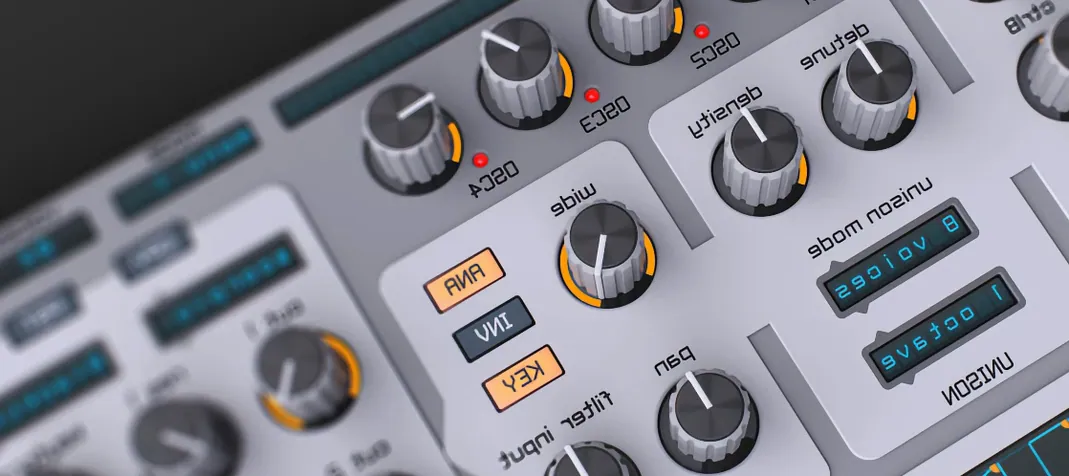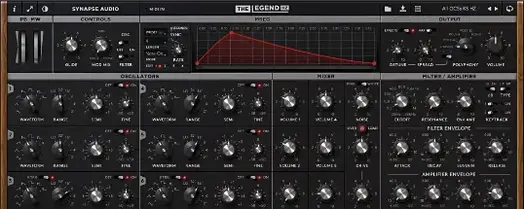
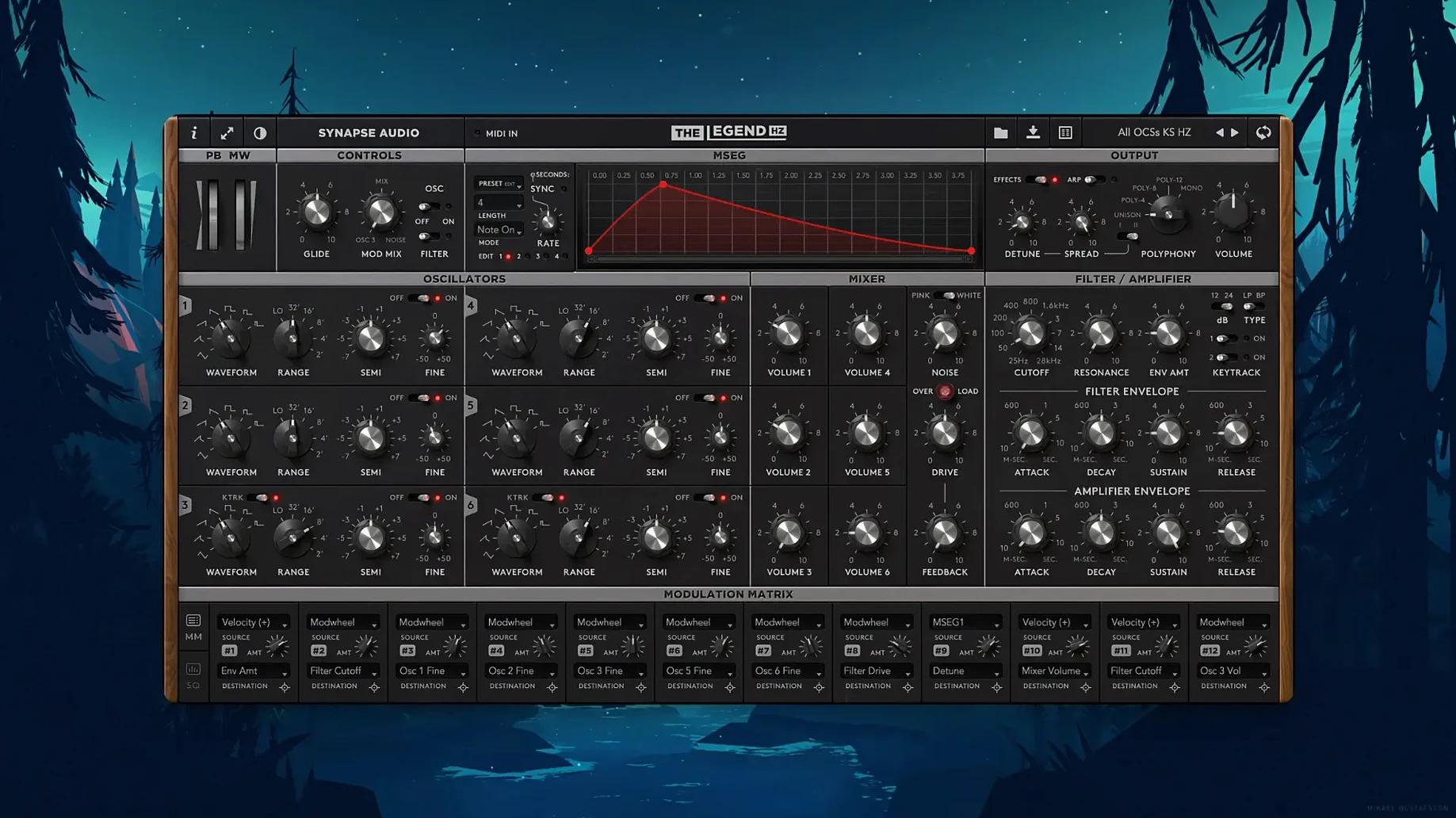
Most soft synths promise analog warmth but deliver something hollow or stiff. The Legend HZ takes a different path — it models a Minimoog-style instrument so closely that the low end has real weight and the filter feels alive. Developed with Hans Zimmer, it gives you six VA oscillators, up to 12 voices of polyphony, and a unison mode that stacks voices for massive leads and basses.
Formats, hosts and what you need to know first
On a Mac, the plug-in arrives in formats that work across every major DAW — from Logic and Ableton Live to Studio One and Cubase. It also supports Native Kontrol Standard, so if you use a Komplete Kontrol keyboard, the presets map automatically to the hardware controls. Projects saved with 23 hz patches will open the original The Legend instrument too, which means you can run both side by side and pull from older soundbanks. Speaking of those: any patches or soundbanks you built for The Legend load right into The Legend HZ without conversion.
What the sound brings to a small shop
The 200 factory presets cover a lot of ground — rounded basses, cutting leads, evolving pads — but the real character comes from shaping things yourself. Version 2.1 added a paragraphic equalizer on the back panel, so you can sculpt the tone before it ever hits your channel strip. There’s also a new compressor saturation circuit that pushes the signal into a warmer, slightly driven territory — useful when a track needs presence without getting harsh. Kevin Schroeder contributed 50 new presets that lean into that saturation nicely. And with MTS-ESP microtuning support now in place, the synth fits into projects that use alternate tuning systems without any workarounds.
In daily use: speed, stability and resource appetite
I keep Activity Monitor open when I’m stacking synth tracks, and The Legend HZ sits comfortably among the lighter analog emulations I run. On an M-series Mac, a four-voice pad patch barely moves the CPU meter — maybe 3–4% per instance. Push it to 12 voices with the 914 filter bank active and you will see a jump, but nothing that forces a freeze or bounce on a modern machine. On older Intel Macs it still holds its own; I have run it on a 2018 Mac mini without the fan spinning up during normal patch browsing.
Loading patches from the original The Legend is instant, and that matters when you are pulling from an older soundbank mid-session. I have not had a single crash when swapping between the two plug-ins in Logic, even on projects that contain both the HZ version and the original. The AU validation passes cleanly every time, and the VST version behaves the same way in Ableton Live — no GUI glitches, no dropped MIDI notes when switching presets quickly.
The back-panel additions in version 2.1 — the paragraphic EQ and compressor saturation — do not add noticeable latency. I checked with a simple kick-and-bass project: the saturation circuit pushes the output without smearing the transient, and the EQ bands respond without the tiny delay some convolution-based equalizers introduce. For a shop owner who records quick demo tracks between packing orders, that kind of reliability means I can work fast and trust what I hear.
How a film composer might reach for it
A composer scoring a tense, atmospheric cue needs a low drone that breathes without drawing attention to itself. She opens The Legend HZ, calls up a basic saw wave patch, and enables the 914 Fixed Filter Bank. She pulls down the 125 Hz and 250 Hz sliders slightly so the drone sits below the dialogue without muddying the low mids. The 1 kHz band gets a gentle boost to add presence, and the 7 kHz slider opens up just enough for the texture to feel airy, not sharp.
With the arpeggiator set to a slow, three-note pattern and the clock synced to the DAW tempo, the drone gains a subtle rhythmic pulse. MPE mode stays off for this cue — she wants the notes to land evenly, without the expressive pitch slides that come from an MPE controller. Twelve voices of polyphony give the pattern room to overlap without stealing notes. She saves the patch, drops a second instance on a new track, and loads a plucked bass preset from the Kevin Schroeder bank. The saturation knob on the back panel gets pushed to about 40 percent, just enough to add bite so the pluck cuts through the low drone. Within ten minutes she has a bed of sound that supports the scene, and the CPU load across both instances barely touches 12 percent — plenty of headroom for the string library that comes next.
Shaping a bass patch from scratch
When I want a bass sound that hits hard on small speakers but still feels full on a club system, I start with an initialized patch in The Legend HZ and build outward.
I pick one saw oscillator, tune it down an octave, and add a second saw oscillator at the same octave with the fine-tuning dialed to about +7 cents. That slight detune gives the low end a slow, thick movement without wobbling out of tune. The third oscillator stays off — I want clarity, not mud. In the mixer section I push oscillator one slightly higher than oscillator two, so the fundamental stays dominant.
The low-pass filter gets set to around 400 Hz with the envelope amount at roughly 60 percent. I pull the cutoff down, then shape the filter envelope so the attack opens quickly and the decay snaps the brightness back within about 200 milliseconds. A short, punchy note length keeps the bass tight against the kick drum.
On the back panel, the paragraphic equalizer gets a narrow dip at 300 Hz to remove boxiness and a small boost at 1.5 kHz for finger noise and articulation. I dial the compressor saturation up to about 30 percent — just enough for a little grit when the filter opens fully. Unison mode stays off for the initial tracking, but I try a two-voice unison with a tiny spread later in the mix to see if it widens the stereo image without losing the center punch. With the six oscillators and 12-voice cap, I could stack more, but for a bass that needs to sit in a dense arrangement, less is usually more. I save the patch, name it something obvious like “Thick Saw Bass,” and drop it into a folder I share between Logic and Ableton Live. That way, no matter which DAW a quick project lands in, the sound is ready.
Version 2.1 brings a few smart additions for shaping tone:
- A paragraphic equalizer tucked onto the back panel for precise frequency sculpting.
- Compressor saturation that adds warmth and drive to the signal.
- MTS-ESP microtuning support for alternate tuning systems.
- 50 new factory presets designed by Kevin Schroeder.
- macOS 10.14 or later
- Intel and Apple Silicon Macs
Questions from the stall
Does The Legend HZ load patches from the original The Legend?
Yes. Any patches or soundbanks made for The Legend can be loaded directly into The Legend HZ.
How many voices of polyphony does it offer?
The Legend HZ supports up to 12 voices of polyphony, along with a unison mode for thicker sounds.
Does version 2.1 work with Komplete Kontrol keyboards?
It does. The plug-in supports Native Kontrol Standard, so presets map to Komplete Kontrol hardware automatically.
Notes from other shops 0
Sign in or open a shop account to leave a note.
No notes yet. If you've used this on a shop Mac, tell me how it went.