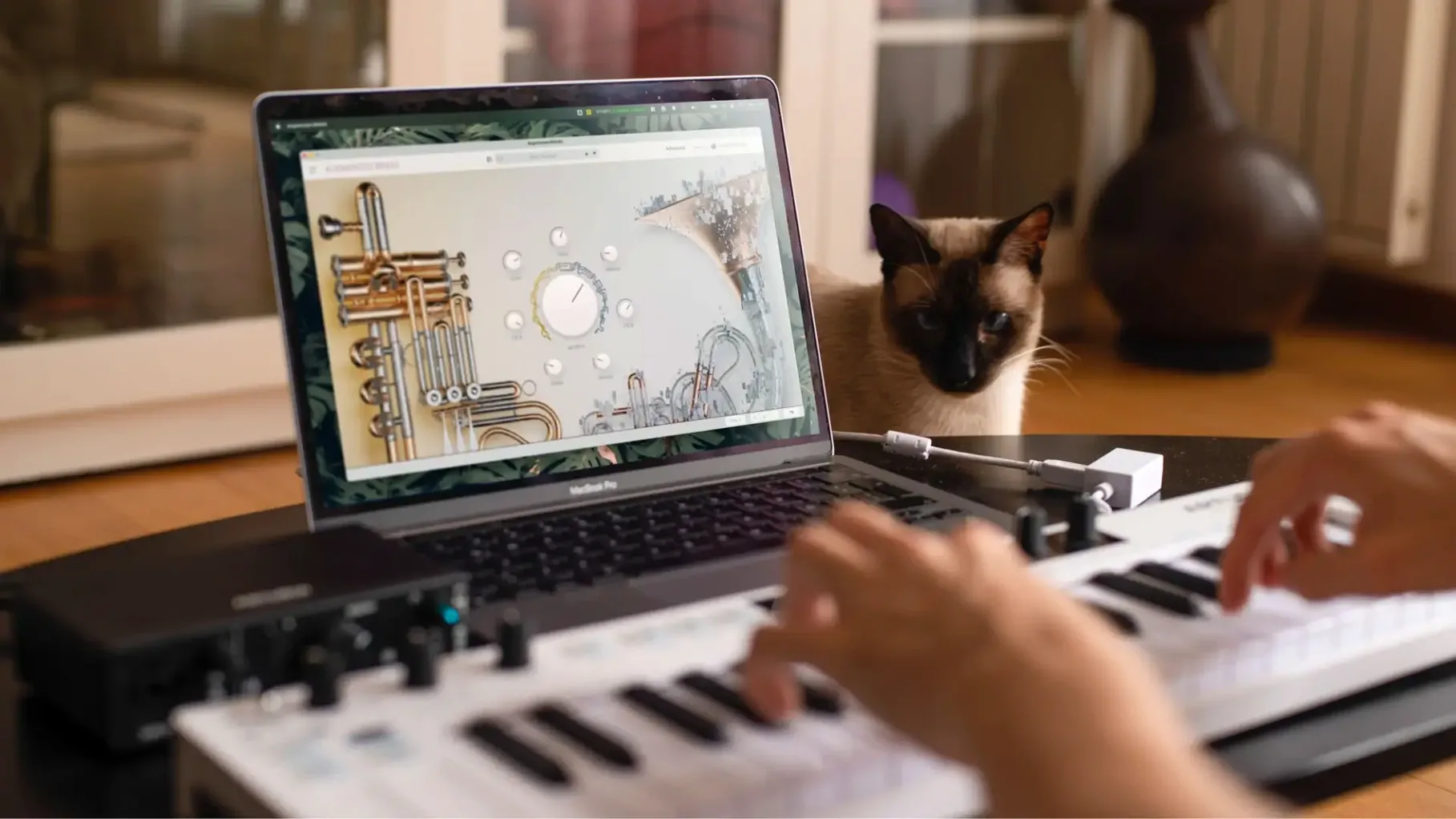
Version 2.0.2.6369 keeps the instrument current on macOS 11 and newer, so the core idea stays the same: brass that moves between acoustic weight and synthetic texture without forcing you to choose one.
Each preset is built from two layers, and each layer holds two sound sources. That means a single patch can pair a close-miked trumpet sample with a filtered saw wave, then let you crossfade or morph between them. The result sits in a mix differently than a straight sample library — you can push a horn section toward glassy, airy, or grainy territory without stacking extra plugins.
The sound sources are the real control point. One side gives you the breath and bite of recorded brass; the other gives you oscillators, noise, and modulation that respond like a synth. Because both live inside the same preset, small movements change timbre more than volume. That is useful when a track needs a brass part to feel present but not literal.
Making a TV drama cue feel tense without sounding like a synth pad
A composer friend who scores episodic television mentioned a problem I hear often: the brief says “nervous, metallic, but still organic,” and a pure synth patch feels too cold while a straight trumpet sample sounds like a period piece. That is where Augmented BRASS clicks. She mapped the mod wheel to the morph control between a muted trumpet sample and a wavetable oscillator, set the attack just slow enough to lose the tongued transient, and got a rising tension cue that the director called “brass, but wrong in the right way.” It sat under dialogue without competing, because the hybrid tone occupies a frequency pocket that neither an acoustic library nor a soft synth would land on by itself.
Building a hybrid horn stab from scratch
Here is a workflow I would use to create a short, punchy horn stab that cuts through a dense electronic track:
- Open the standalone version or load the plugin on an instrument track in your DAW.
- Start from an init preset so both layers are blank.
- On layer A, source one choose a tenor saxophone sample — something with natural breath noise. Keep the octave centered.
- On layer A, source two choose a simple square-wave oscillator. Detune it by about 7 cents for a slightly unsettled edge.
- Set the morph position around 60% toward the sax so the body reads as brass but the attack has a clipped, synth-forward bite.
- On layer B, pick a trombone ensemble sample and pair it with a noise source. Roll off the noise above 4 kHz with the onboard filter so it adds grit without hiss.
- Balance the two layers so layer A leads the transient and layer B fills the sustain.
- Apply a short amp envelope: fast attack, decay around 400 ms, sustain low, release quick. You want a stab, not a pad.
- Add a touch of the built-in reverb — just enough to place it in a room, not wash it out.
- Save the preset and test it against a drum loop and a bassline. Tweak the morph slider while the loop runs to find the spot where the stab punches without masking the kick.
That whole process takes about ten minutes, and the result is something a pure sample pack or a pure synth would not give you: a brass sound that feels played but hits with the consistency of a synthesized one-shot.
More texture engine than traditional brass library
People sometimes ask how this stacks up against Output Analog Brass & Winds or Native Instruments Session Horns Pro. The difference is philosophy. Session Horns Pro aims for realism — articulations, section sizes, divisi writing. It is a traditional sampled brass library dressed for pop and funk arranging. Augmented BRASS does not try to replicate a real section; it treats brass recordings as raw material to fuse with synthesis.
Analog Brass & Winds from Output leans into cinematic hybrid territory too, but it relies more on dual-layer sample engines and baked-in tape and pedal effects. Augmented BRASS gives you direct oscillator and noise sources inside the preset, so the synthetic side feels more like a real synth voice you can tune, detune, and modulate, rather than a processed sample. For a producer who already knows subtractive synthesis, that means less time learning a new engine and more time shaping tone.
If your work is orchestral mockups where authenticity matters, a library like Session Horns makes more sense. If you want brass that can dissolve into pads or hit like a synth blast without switching plugins, Augmented BRASS fills that gap. It is a sound design tool wearing brass clothing.
It runs standalone or as VST, AAX, Audio Unit, and NKS, so it drops into most Mac setups without much fuss.
Good news if you are on an older setup: version 2.0.2.6369 is listed for Mac OS 11.0 and up, so the instrument keeps working on machines that have not jumped to the newest macOS.
- macOS 11 or newer
- Intel or Apple Silicon Mac
- 4 GB RAM
- 4-core CPU at 3.4 GHz or an M1 CPU
- 6 GB free disk space
Questions from the stall
What formats does Arturia Augmented BRASS work in?
It runs in Standalone, VST, AAX, Audio Unit, and NKS formats on Mac and Windows.
Notes from other shops 0
Sign in or open a shop account to leave a note.
No notes yet. If you've used this on a shop Mac, tell me how it went.