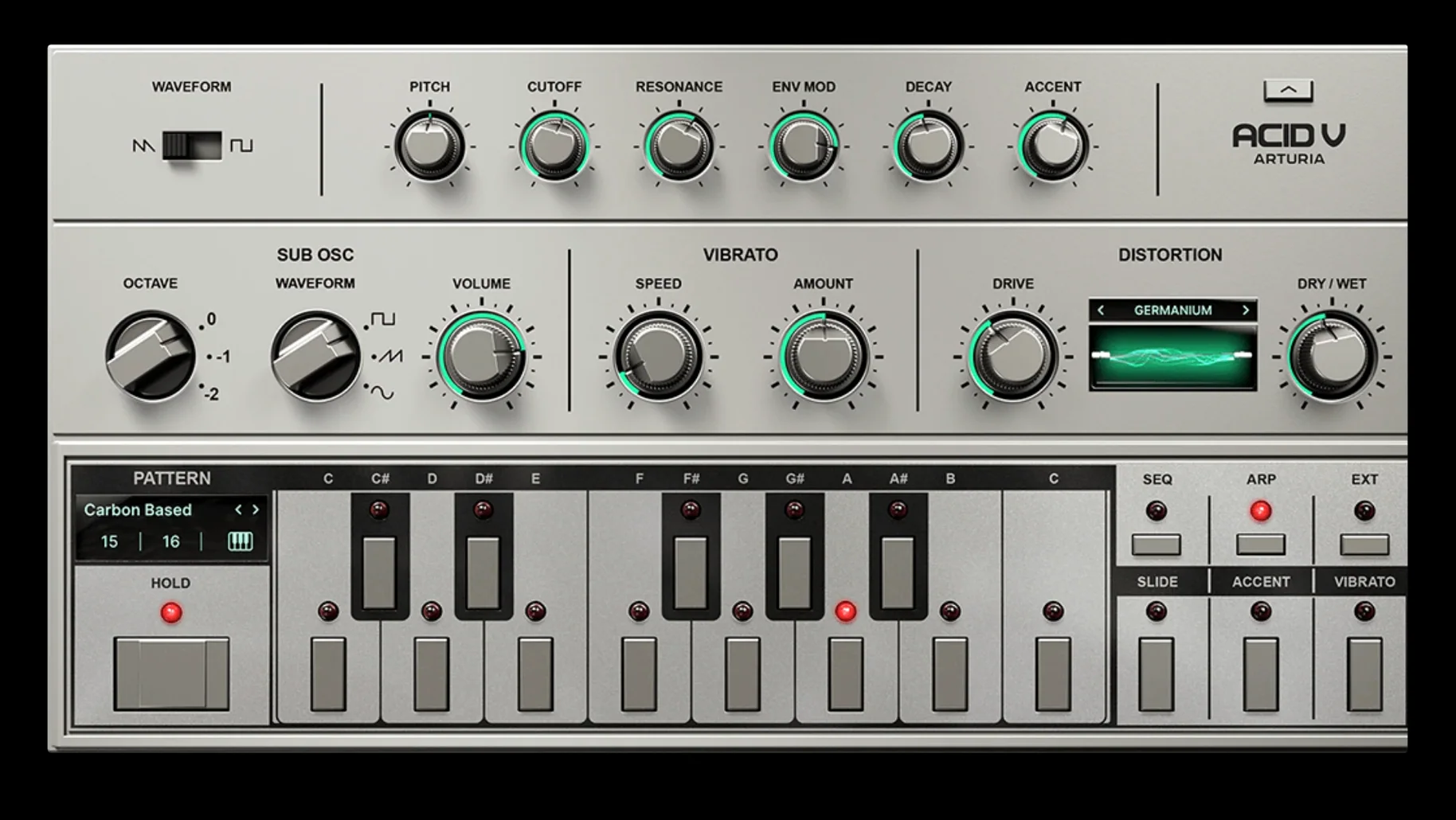
The Vibrato generator is the first place I go when a pattern needs to move. It's one of three multi-mode function generators and it can push a static line into wobbling, seasick territory before you've even touched the filter. Here's a typical session path.
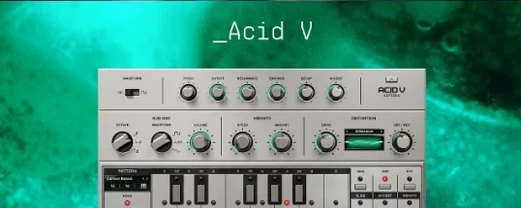
- Drop it on an instrument track. Acid V works as a software instrument, so I load it directly on a MIDI track and route a controller or draw notes into the piano roll. The internal sequencer handles slides and accents like the original hardware, but I often send simple note triggers and let the onboard sequencer do the heavy lifting.
- Build the oscillator foundation. The analog oscillator gives you square and triangle waveforms, and the sub-oscillator adds weight across a 2-octave range with three waveforms of its own. I usually blend a thin triangle wave with a beefy sub-square to get that hollow-but-solid low end.
- Carve with the resonant low-pass filter. This is where the corrosive character lives. A touch of resonance and a slow envelope sweep from one of the function generators turns a dry pattern into something that snarls. I ride the cutoff manually when I want the track to breathe.
- Send to a bus for space. The plugin output stays clean, so I send it to a delay or reverb bus. Acid V's raw tone takes well to a short ping-pong delay and a touch of spring reverb, which sit behind the dry signal without muddying the attack.
Acid V fits into a session like a hardware synth in a patchbay — it owns one job and does it with an attitude that sits forward in a mix without a fight.
Feed it plain MIDI, skip the internal patterns
The main question is about the sequencer. Yes, you can absolutely feed it plain MIDI notes from your DAW and ignore the internal pattern engine entirely. The polymetric sequencer is there when you want slides, accents, and the rubbery timing that a piano roll can't quite replicate, but it's not mandatory. I bounce between both methods depending on the track — MIDI for quick ideas, the internal sequencer when I want a line to squirm.
Another common one: does it only do acid? The 303 lineage is unmistakable, but the distortion module alone — fourteen algorithms, from soft clip to outright destruction — pushes it past genre boundaries. Couple that with the four FX slots and seventeen effects, and you're in territory the original hardware never hinted at. I've used it for degraded pad textures and percussive stabs that nobody would tag as "303."
People also ask about tuning flexibility. The MTS-ESP microtuning support means it sits comfortably in projects that aren't locked to equal temperament, which opens it up for film scoring and experimental work. No extra hoops to jump through.
A working session, story-shaped
I open a project that needs a low-end pulse — something that feels alive, not just a repeating note. Acid V loads with a preset called something aggressive, but I strip it back to the init state. The oscillator starts as a bare triangle wave, clean and almost polite.
I dial the sub-oscillator down an octave and blend in a square wave at about forty percent. That hollow body appears instantly. Next I grab the filter cutoff and pull it down until the sound is mostly shadow, then assign one of the function generators to open it on every other beat. The pattern breathes unevenly now, like it's leaning into the kick drum.
A touch of vibrato from the dedicated generator adds pitch wobble that peaks just as the filter opens. I audition a few distortion algorithms — the tape-style saturation wins because it rounds the transients without losing the bite. Into the FX slots I drop a short stereo delay and a modest plate reverb, both set to wet levels low enough that they're felt more than heard.
Twenty minutes in, the bassline isn't supporting the track anymore. It's driving it.
What's new in the latest release:
- The macOS package for version 1.1.5.6367 is now available.
- macOS 11.0 or later
- Runs on both Intel and Apple Silicon Macs
Questions from the stall
What kind of synthesizer is Arturia Acid V?
It is an enhanced software emulation of the Roland TB-303 bassline synthesizer, with an analog oscillator, sub-oscillator, resonant low-pass filter, and three multi-mode function generators for modulation.
Notes from other shops 0
Sign in or open a shop account to leave a note.
No notes yet. If you've used this on a shop Mac, tell me how it went.