Nuendo is a professional audio post-production workstation built for dialogue editing, immersive mixes and the fast deadlines of film, television and games.
What makes the Analyzer track useful?
The Analyzer track gives you a clear visual read on frequencies while you work, so decisions about dialogue cleanup or effects placement happen with your eyes and ears working together.
What does Quick Link do for my workflow?
Quick Link and the MIDI port or channel adjustments make it easier to connect tracks and control surfaces without rebuilding routing every time a session changes hands.
How do imported track settings help?
Improvements to imported track settings and track archives mean you can bring in material from other projects with more of your routing, naming and processing intact — less time rebuilding, more time mixing.
What about performance with plug-ins?
Keeping my Mac stable on a mixed-use shop machine
I keep an eye on system resources because my shop machine is also my design machine — it earns its keep every day, and I can't afford sessions that stutter while I'm trying to work. In daily use on Apple Silicon, Nuendo 15.0.30 idles lightly. I'm seeing maybe 2 to 3 GB of RAM with a moderate film session open and the mixer window visible, and CPU sits low when transport is stopped. Playback with 80 to 100 tracks, a few convolution reverbs and some dialogue processing bumps the CPU up, but it's well-behaved.
The Multiband Envelope Shaper optimization is one of those quiet fixes that matters more than it sounds. In earlier builds, bypassing a plug-in didn't always let go of the processing cycle, and you'd feel it when you stacked a dozen instances across a dialogue group. Now bypassing genuinely frees up the core, so your edit density doesn't punish you while you're still trying things out.
On Intel machines with macOS 11, the application opens a little slower on first launch — maybe 12 to 15 seconds while it scans plug-ins — but once it's up, the mixer redraws are smooth and the Comp Tool with Group Editing fix means grouped tracks don't lag behind when you slide a crossfade. I haven't hit a beach ball during a normal edit since the update.
The download is under 1.8 GB, which is modest for a workstation of this scale, and the installer doesn't scatter files everywhere. If you're looking around for a way to try it, some people search for nuendo 15 torrent or nuendo mac torrent to get a sense of what the package looks like before committing, which I understand — a test drive tells you more than a spec sheet ever will.
Where Nuendo fits when you’re building game audio and immersive mixes
I've spent time with three other heavyweights that overlap with what Nuendo does, and the differences come down to what you're building.
Compared to Pro Tools Ultimate, Nuendo feels more fluid for game audio and immersive formats. Pro Tools still dominates in music-centric post houses, but Nuendo's built-in ADM authoring and object-based panning don't need a separate renderer or a pile of auxiliary tracks. Where Pro Tools asks you to route around its architecture for Dolby Atmos, Nuendo treats it as a native format. On the other hand, Pro Tools has a deeper pool of third-party control-surface profiles, so if your room already has an S6, that's a factor.
Next to Logic Pro, the comparison gets a little unfair — Logic is a music-first DAW that happens to do post, while Nuendo was built for picture from the beginning. Logic's price-to-feature ratio is remarkable, and its stock plug-in library is larger, but Nuendo's dialogue editing tools, field-recorder workflows and the Analyzer track make a real difference when you're cutting production sound at 10 a.m. and delivering stems by 4 p.m. Logic also lacks integrated loudness measurement that follows the EBU R128 spec as closely, which matters if you're delivering for broadcast.
Then there's DaVinci Resolve Fairlight. If you're already grading in Resolve, Fairlight is a logical place to do a quick mix, and the round-tripping is obviously tighter. But in a dedicated audio room, Nuendo pulls ahead once you need advanced automation modes, the full Comp Tool with group editing, or a session that has to travel to another facility. Fairlight's automation lanes are simpler; Nuendo's are more mature. I've had colleagues search for nuendo 14 download or nuendo torrent just to compare the automation handling side by side with Fairlight, and the difference in precision is real.
A morning in local commercial and short film work
Let me walk you through what a morning might look like. I'm not claiming to be a feature-film re-recording mixer — I'm a shop owner who handles local commercial work and the occasional short film — but the rhythm translates.
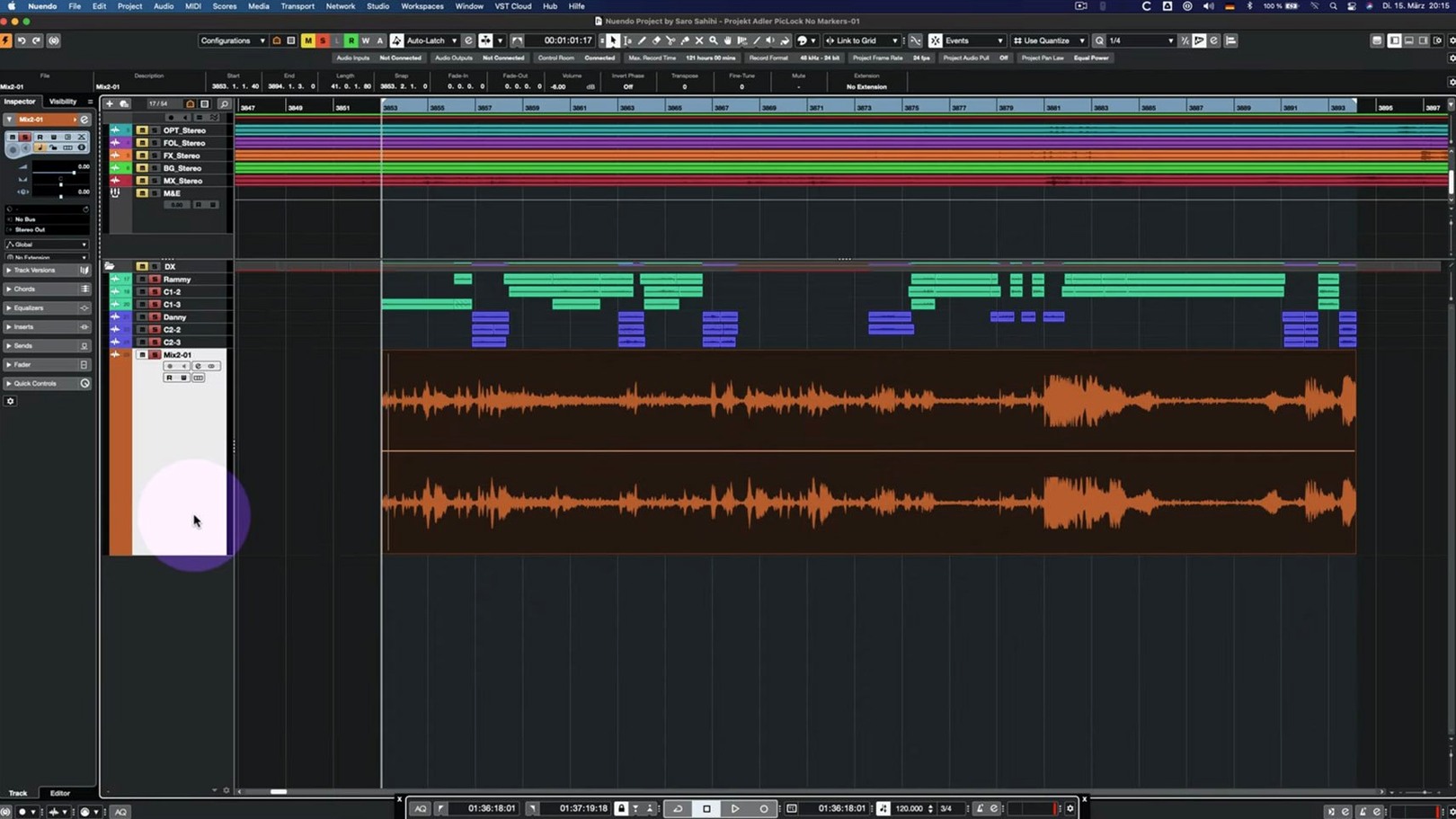
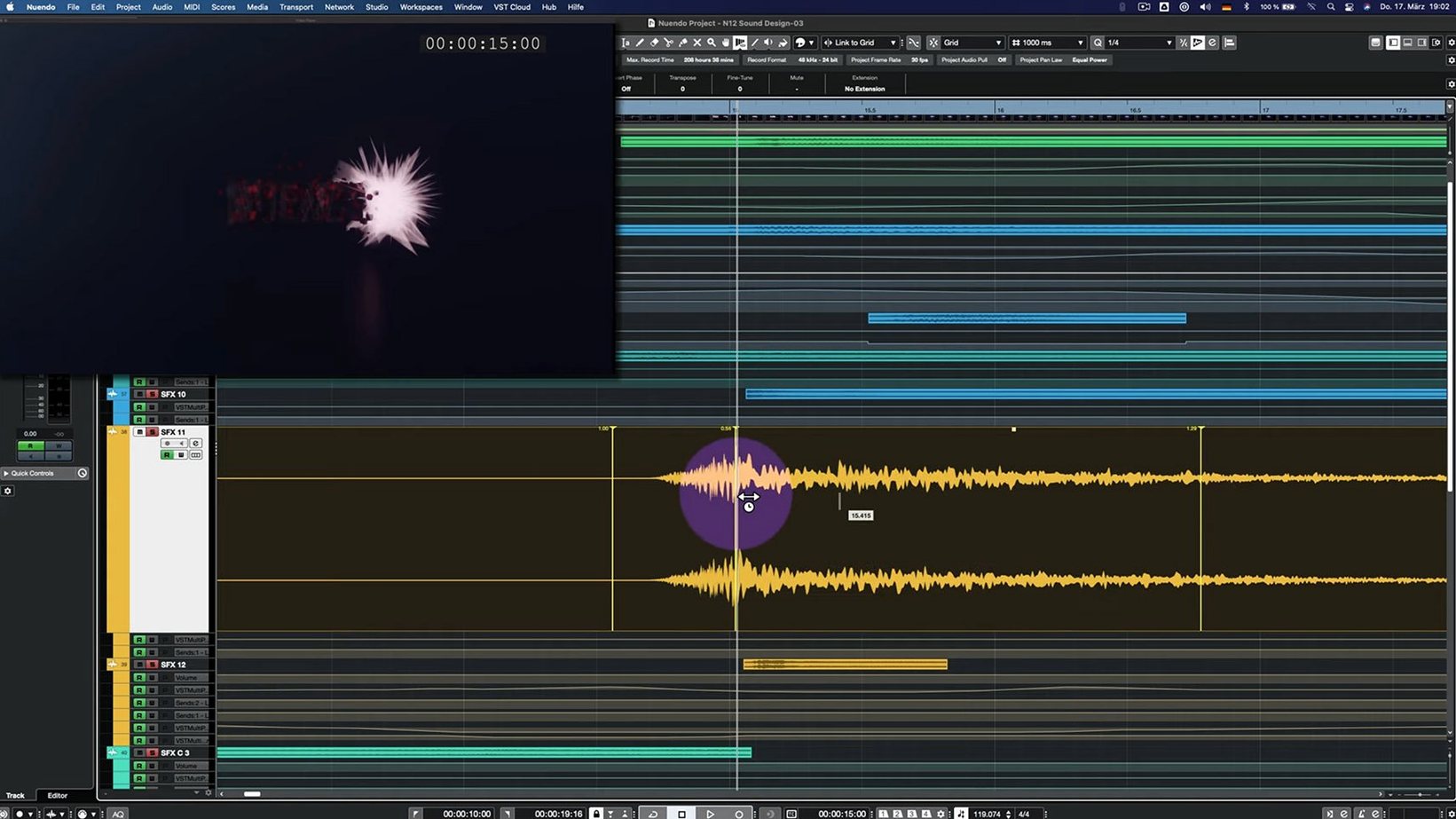
I open a project from an external SSD. The session has a reference video, a dozen dialogue tracks from production, three stereo ambience beds and a folder of spot effects. The video starts as a small floating window on my second display. First thing I do is solo the dialogue group and listen through, dropping markers where I hear plosives, clothing rustle or a line that needs an alternate take. The Comp Tool with Group Editing lets me drag takes from the production assembly across all matching boom and lav tracks at once, so the phase relationship stays intact.
Next I open the Analyzer track on the dialogue bus. I'm looking for a low-mid buildup around 200 Hz that's common in small indoor locations. I see it, drop an EQ on the bus and pull it back gently while I watch the curve settle. No guesswork — I'm not just hearing the mud clear, I'm watching it.
With dialogue roughed in, I import ambience tracks from a template using the improved track archive handling. The routing, bus sends and naming come in clean — I don't have to reassign outputs or re-label anything. Quick Link then ties my fader controller to whichever track I select, so I ride ambience levels against dialogue without stopping to map MIDI ports. By noon I have a presentable temp mix, and I haven't opened a manual or rebuilt a single routing path.
Some people I know who work on game cinematics look for nuendo 12 free download full version with crack or similar searches when they're between contracts and need to keep their home setup compatible with what a studio expects. I get the instinct — consistency across machines matters when you're passing sessions around.
Settings I'd change on day one
Out of the box, Nuendo makes a few assumptions that don't match how I work. Here's what I'd adjust right after install.
- Auto-save interval. The default is conservative. I shorten it to five minutes and bump the number of backup copies to ten. Post sessions get complex quickly, and a corrupted project file at 9 p.m. is a special kind of heartbreak.
- Record file format. Switch it to Broadcast Wave 48 kHz / 24-bit if your templates don't already enforce it. The default has occasionally leaned toward 44.1 kHz in older versions, and broadcast wants 48.
- Plug-in scan on startup. Turn off automatic rescan unless you're adding new plug-ins that day. It shaves several seconds off every launch, and on a busy morning, seconds count.
- Folder track routing. The 15.0.30 update refined how folder tracks behave when they carry Group Channel functionality. I set my folder tracks to act as dedicated group busses from the start — dialogue, FX, music, ambience — so every sub-mix has a clear fader and insert chain before it hits the main output.
- Quick Link MIDI behavior. Under Preferences, I set Quick Link to follow track selection rather than remaining locked to the last selected channel. That way my fader controller always jumps to whatever I'm focused on.
These are small changes, but together they make the application feel like it's tuned for speed rather than for a generic first launch. And for post-production, speed is really the whole idea.
The Multiband Envelope Shaper got a bypass performance optimization, so heavy sessions stay responsive even when you have a stack of processing on a track.
Version 15.0.30 is a maintenance update with fixes and refinements across the board. The changes that caught my eye:
- Analyzer track changes
- Updated folder track routing and Group Channel behavior
- Better handling of imported track settings and track archives
- Adjusted Quick Link and MIDI port or channel behavior
- Fixes for the Comp Tool with Group Editing
- Score Editor fix for locked global tracks
- Direct Offline Processing interface fix for VST Bass Amp and VST Amp Rack
- Bypass performance optimization for the Multiband Envelope Shaper plug-in
- macOS 11 or later
- Works on Intel and Apple Silicon Macs
- Interface language: English
- Download size: under 1.8 GB
Questions from the stall
Is Nuendo available in English?
Yes, the interface is available in English.
Notes from other shops 0
Sign in or open a shop account to leave a note.
No notes yet. If you've used this on a shop Mac, tell me how it went.