What changed in MAMP PRO 6.9
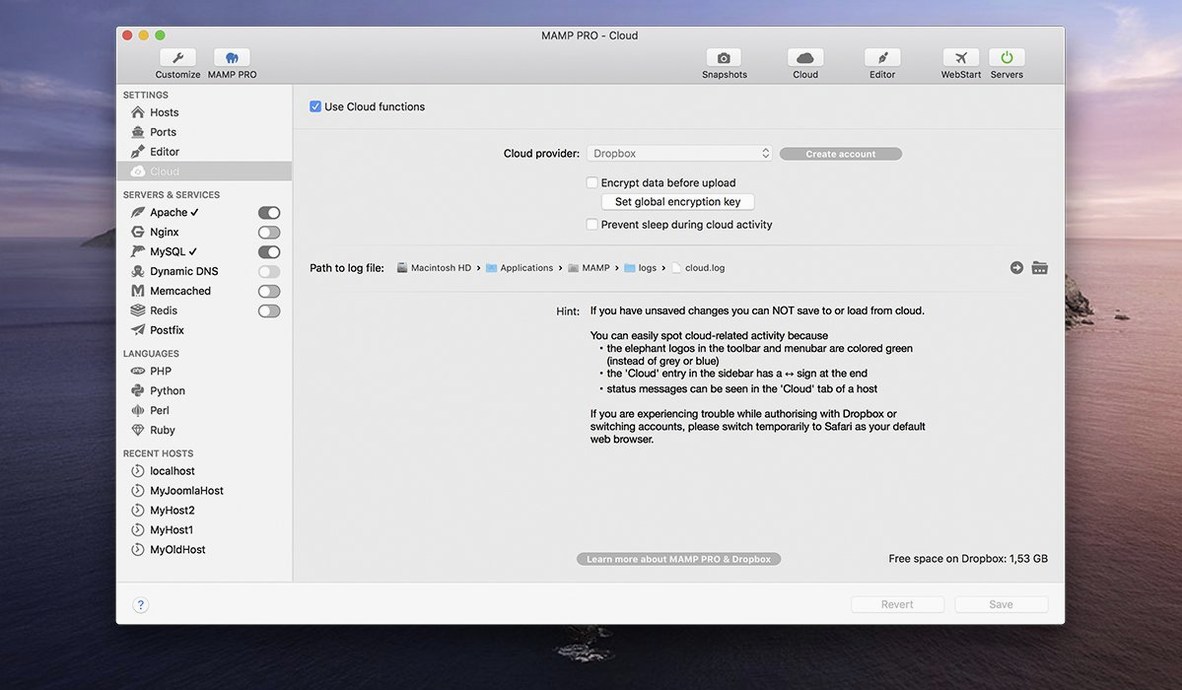
This update smooths out a few rough edges. Installing additional PHP versions is more reliable now. If you ran into a crash while tweaking host-specific server settings, that's fixed. The MAMP Cloud feature also got attention for some underlying network problems, and opening phpMyAdmin 5 through an alias should work without a hitch.
Give every project its own server setup
- Can I give each project its own setup?
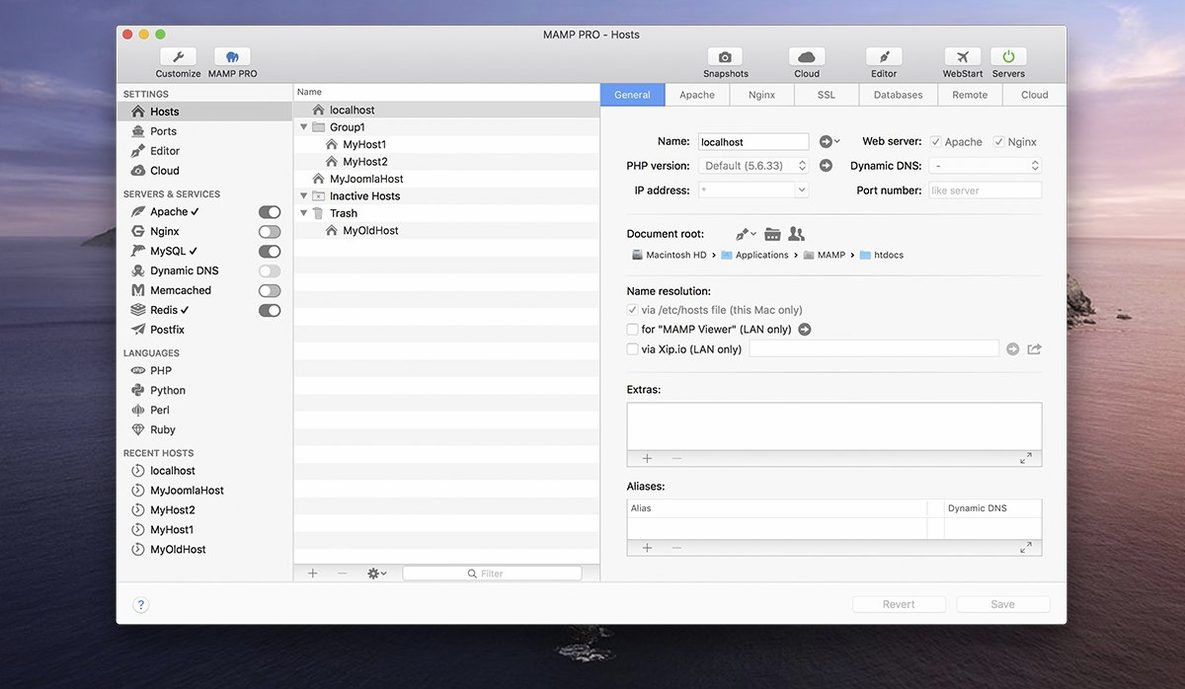
Yes. You create a separate host for every web project, with its own server and PHP configuration. The host creation dialog has been streamlined so it's quick to get going. - How does a site go from my Mac to a live server?
Once a project is ready, you can publish it directly to your production server right from the app. There's also a remote editing option and tools for importing or migrating WordPress sites between servers.
Think of it as a local development environment for PHP and MySQL that doesn't treat every site the same. The redesigned toolbar puts common actions closer, and the separate host approach means your test environment can mirror what each project actually needs.
Turns one local server into a fleet of independent hosts
If you have been poking around for a download mamp pro 6 link, you have probably wondered how different it really is from the free version. The short answer: it is the layer that turns a single local server into a manageable fleet of project-specific environments. Instead of one generic localhost, you get a named host with its own PHP version, its own document root, and its own server choice — Apache or Nginx. That is the thing most newcomers want confirmed before they commit the disk space.
Another frequent question is whether it plays nicely with existing MySQL setups. It does, and it ships with MySQL 5.7 and 8.0 side by side. You pick the version per host. People who maintain older WordPress sites especially appreciate that, because not every legacy theme or plugin is ready for MySQL 8. Redis and Memcached integration are built in too, so caching layers do not require a separate scramble through Homebrew.
And yes, you can keep the free MAMP around. They coexist. MAMP PRO reads its own data directory and leaves the basic MAMP untouched. If you are searching for mamp pro torrent or mamp torrent alternatives, you will still want that clean separation so your work projects never tangle with quick-and-dirty experiments.
Drag hosts to match your mental project map
A couple of features hide in plain sight. The host list supports drag-and-drop reordering — grab a host and slide it up or down to match your mental map of the project. Not life-changing, but after the tenth site it keeps the list readable.
The screenshot capture tool is another quiet helper. Hit it before sending a client a preview, and you have a timestamped image of the local site without opening a separate utility. It saves directly into the host's folder, so screenshots stay paired with the project they belong to.
Remote editing works through a small checkbox in the host settings. Turn it on, and any editor that understands remote paths can open files directly from the running host. No manual SFTP mounts. The redesigned toolbar puts host start, stop, and the phpMyAdmin alias within a single click — phpMyAdmin 5 via alias was specifically improved in 6.9 after some earlier hiccups.
WordPress users get a one-click installer during host creation. The optimized dialog pre-fills sensible defaults, so the time from “new host” to “WordPress dashboard” is shorter than making coffee. Once the site exists, the publish and import tools handle moving it to and from a live server without a separate migration plugin.
Assign a different PHP version to each client site
The obvious group is WordPress developers juggling several client sites. Each host gets its own PHP version — 7.4 for that one stubborn theme, 8.2 for the fresh build — and MySQL 5.7 or 8.0 as needed. No global switching, no forgetting to flip a version before pulling a backup.
Agency folks and freelancers who do mamp pro crack mac searches are often looking for exactly that per-project isolation without a monthly subscription. The host-specific server configuration means you can mimic a client's production environment closely: choose Apache with certain modules enabled for one project, Nginx with a custom config for another.
Less obvious: designers who picked up enough PHP to tweak templates. The separate-host model means a broken experiment does not take down the whole local server. Stop one host, fix the code, restart it — everything else keeps running. Remote editing and screenshot capture feel designed for exactly this kind of visual, iterative workflow.
Even developers hunting for mamp pro 7 crack mac or similar searches often realize 6.9 already covers the stack they need. Intel Macs on macOS 10.12 and Apple Silicon machines on macOS 11.0 or later are both supported, and the 64-bit Intel build runs smoothly under Rosetta 2.
Create one host by hand before you import anything
Start by creating one host manually before importing anything. Walk through the host create dialog slowly — check the PHP version dropdown, pick Apache or Nginx, and note where the document root lands. That small investment makes importing or publishing feel predictable later.
Name hosts the way you will search for them. A client-project slug works better than “test” or “wordpress-local.” The host ordering feature becomes more useful when names are distinct at a glance.
If you use WordPress, let the one-click installer set up the first site, then export it and import it back as a second host. This gives you a fast dry run of the publish-migrate loop without touching a live server. The MAMP Cloud fixes in 6.9 make that network path more reliable than earlier builds, so the practice run is worth the five minutes.
Enable Redis early, even if you do not think you need it. Some plugins and themes check for object caching on activation, and having it available from day one prevents head-scratching later. The same goes for picking MySQL 8.0 for new projects unless you have a specific reason to stick with 5.7.
Finally, pin phpMyAdmin to the toolbar mentally — the alias improvement in 6.9 means opening it is now a single click from the main window. When a database tweak is needed mid-flow, that small speed bump removal adds up.
Version 6.9 tidies up a few trouble spots:
- Fixed a crash that happened when editing host-specific server configurations.
- MAMP Cloud had several network-related issues—those are resolved.
- Installing additional PHP versions is smoother now.
- Opening phpMyAdmin 5 via an alias works properly again.
- macOS 10.12 or later
- Runs on Intel and Apple Silicon Macs
Questions from the stall
Can I give each project its own setup?
Yes. You create a separate host for every web project, with its own server and PHP configuration. The host creation dialog has been streamlined so it's quick to get going.
How does a site go from my Mac to a live server?
Once a project is ready, you can publish it directly to your production server right from the app. There's also a remote editing option and tools for importing or migrating WordPress sites between servers.
Notes from other shops 0
Sign in or open a shop account to leave a note.
No notes yet. If you've used this on a shop Mac, tell me how it went.