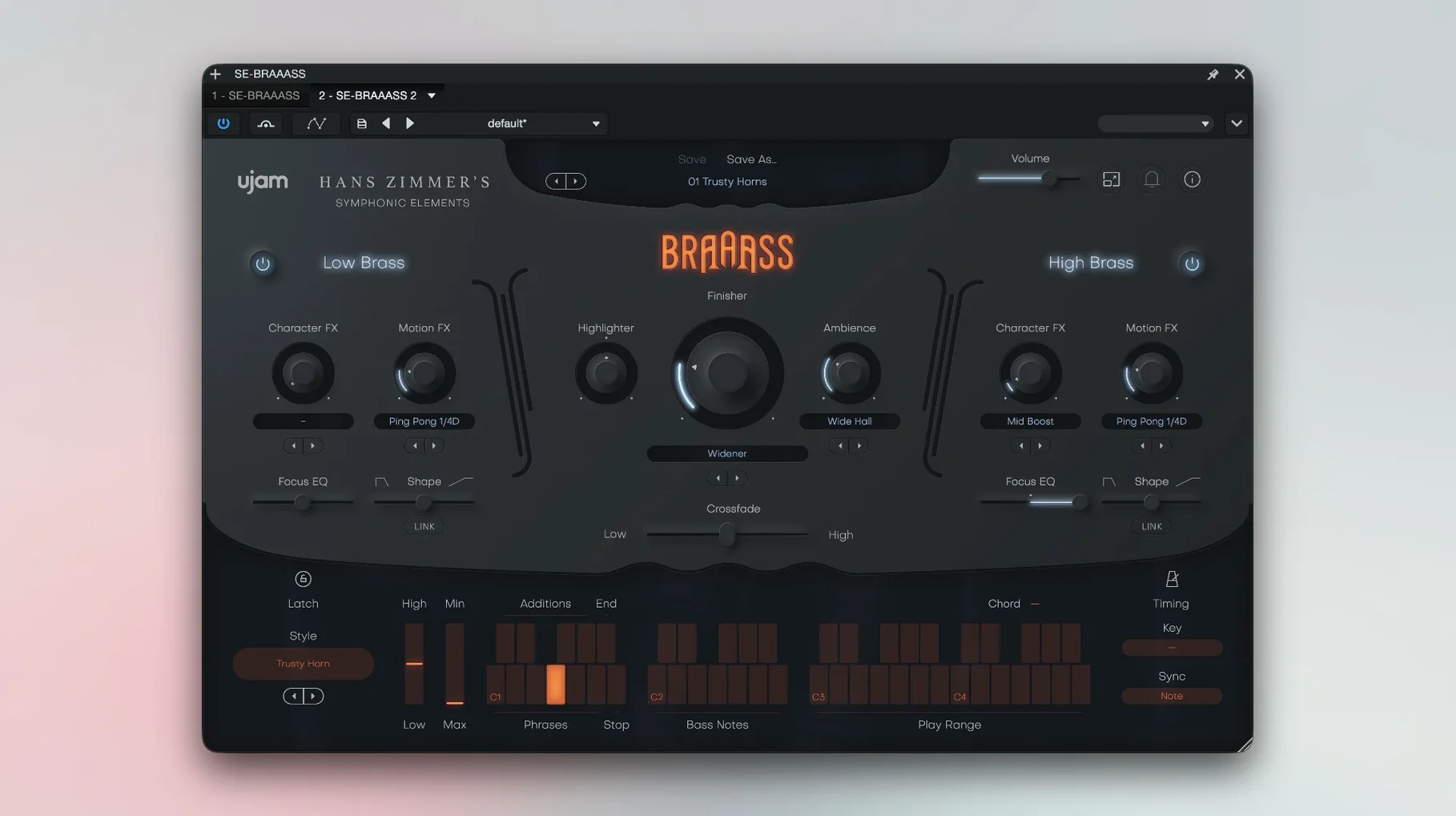
uJAM Symphonic Elements BRAAASS is a brass phrase instrument plug-in that puts a full cinematic horn section at your fingertips. It runs on Intel and Apple Silicon Macs as an AU, VST, or AAX plug-in inside your DAW, and it’s built to let you shape dramatic brass passages without touching a single note of MIDI.
- Stays in sync with your host tempo and key, so phrases lock to your project immediately.
- Six ready-made styles, from aggressive stabs to flowing melodic lines, each with six phrases you can trigger and chain.
- Separate high and low frequency sections let you balance trumpets and French horns against trombones, cimbassos, and tubas independently.
- Reverse playback mode flips any phrase backwards for eerie swells and transitional effects.
- Drone controls create sustained, evolving textures from the brass ensemble for underscoring tense scenes.
What I’d reach for here is the low-end weight. The cimbasso and tuba combination brings a gravelly authority that smaller brass libraries miss, and the reverse trigger turns standard fanfares into something genuinely unsettling. Pair it with a string patch from the same series and you’ve got a quick, cohesive orchestral sketch pad.
Film composers working against the clock
Film composers on a deadline get the most mileage here. The phrase-based design means you’re not auditioning individual articulations or drawing controller curves for fifteen minutes — you pick a style, hold a chord, and the performance is already moving. That matters when picture lock happened yesterday and the director wants three cue revisions before noon.
Beatmakers and hip-hop producers who sample orchestral records will also find it a natural fit. The reverse trigger and the Finisher knob give you that dusty, flipped-brass texture without digging through crates or fighting clearance issues. Trap and drill tracks benefit from the low brass weight — a single sustained drone layered under an 808 does more than most synth pads ever could.
Sound designers working on game audio or trailer spots tend to ignore the melodic phrases entirely and live in the drone and reverse modes. Dragging a reversed cimbasso swell through the crossover fader while the Finisher adds grit creates risers that feel organic, not synth-built. Tip: automate the crossover fader during a reverse phrase to shift the spectral focus mid-swell — it keeps the ear from predicting where the sound is headed.
Scoring a tense reveal in under ten minutes
Here’s a workflow I’d use for a scene where a character opens a door and discovers something they shouldn’t. The picture cuts from a hallway to a dark room, and the director wants the score to breathe but tighten.
- Load BRAAASS on an instrument track and set the key to match your project. Pick a low brass style with slow attack — something built from trombones and tuba — and trigger the third or fourth phrase in the set.
- Pull the high section fader down to about 30% and leave the low section full. The trumpets recede, and the weight sits where the tension lives.
- Enable the drone layer underneath. Dial the drone volume so it’s felt more than heard — just a hum beneath the phrase that keeps the scene from feeling empty between notes.
- On the downbeat of the door opening, automate the Finisher from clean to about 40% saturation. The brass frays at the edges, and the room suddenly feels colder.
- Hit the reverse trigger on the final phrase repeat. What was a descending motif now crawls upward and backward, landing exactly on the cut to black.
The whole thing takes a few minutes, and nothing sounds like a keyboard stab because the phrases carry real player phrasing and breath. You’re arranging performances, not assembling samples.
No brass voicing knowledge needed
Do I need to know brass voicings to use this? Not really. The phrases were recorded with proper section writing, so the interval relationships and voice leading are baked in. You hold a chord shape, and the instrument distributes it across the ensemble sensibly. If you do know your way around horn parts, the separate high and low faders give you enough control to push certain sections forward or tuck them back without opening a score editor.
Will it work alongside other orchestral libraries I already own? It sits nicely in a template. Because the sound carries the room tone of Hans Zimmer’s actual recording spaces, it tends to blend with drier sample libraries rather than fighting them. I’ve seen producers use it for the upfront, moving brass line while backing it with a traditional multi-articulation library for sustains and stabs. The crossover fader helps you carve the frequency space so the two sources don’t pile up in the same octave.
Is it only useful for epic, loud moments? The loud stuff is obvious, but the softer end of the preset list is where the instrument surprises people. Muted French horn phrases with the Finisher set to a gentle chorus widening can sit under dialogue without stepping on it. The drone section alone, set to a low tuba cluster with slow attack, works as a bed for intimate scenes where a full string pad would feel too sentimental. Many users who grab uJAM Symphonic Elements BRAAASS torrent macOS are pleasantly surprised by how much quiet material lives inside a brass plug-in marketed for bombast.
- macOS 10.15 or later
- Intel 64-bit or Apple Silicon processor
- AU, VST, or AAX compatible host
Notes from other shops 0
Sign in or open a shop account to leave a note.
No notes yet. If you've used this on a shop Mac, tell me how it went.