If you already use a sampler or a drum machine plug-in in your DAW, Beatmaker VICE slots into that same role — just with a tighter decade. It loads onto an instrument track and responds to MIDI, so you can program parts the way you normally would, or browse its built-in patterns and drag them straight into your arrangement.
Where VICE fits in a session
- Instrument track. Load VICE on a software instrument track. It arrives as a stereo drum module, ready to play.
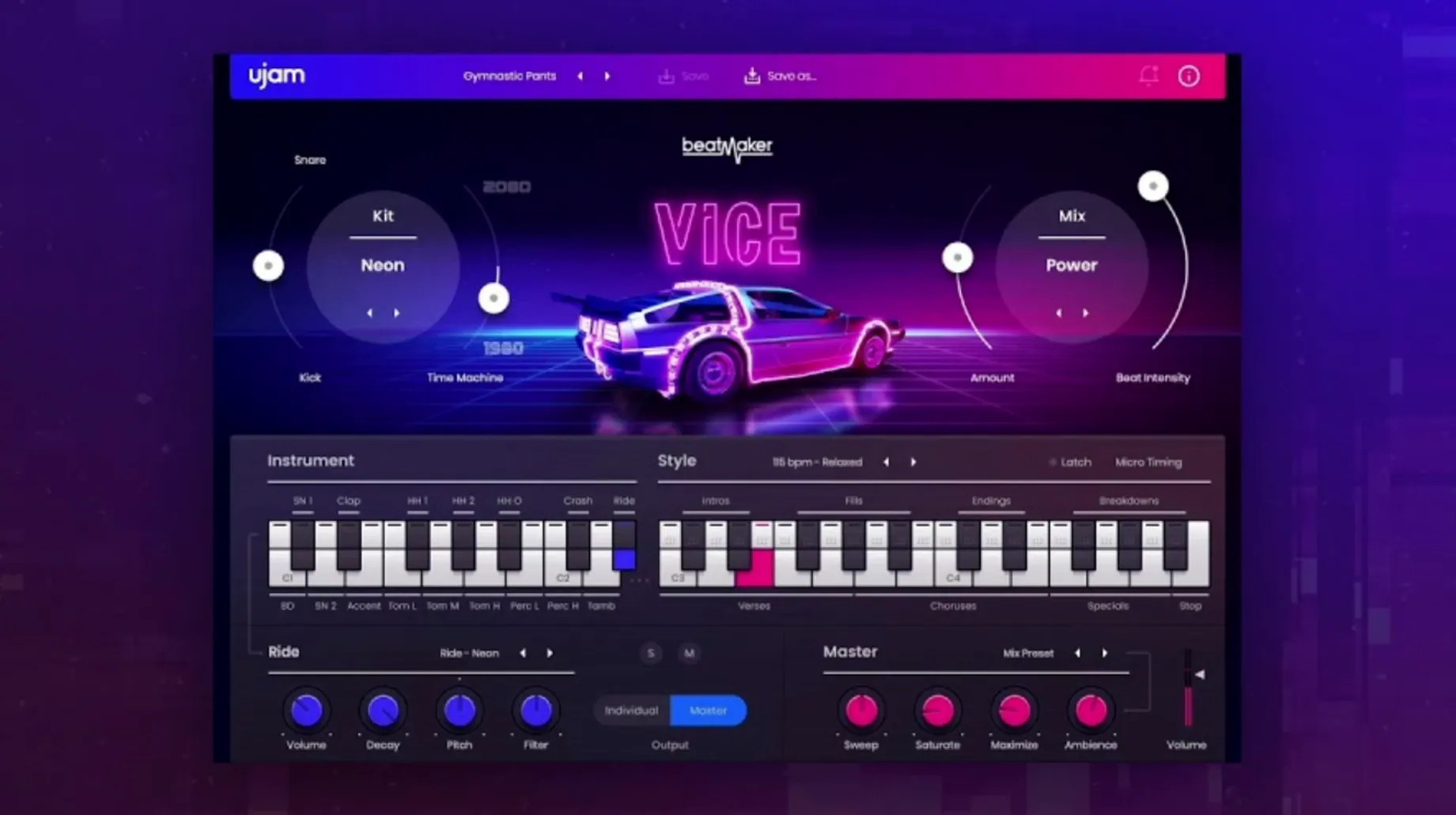
- Pattern browsing. Audition the 460 patterns across 20 styles. When something clicks, drag the MIDI into your track lane and tweak from there.
- Sound shaping. Each of the 10 kits combines 1980s drum machine character with modern processing. Swap kits while the pattern plays — the feel changes immediately.
- Parallel bus. Route the plug-in to a separate aux for parallel compression or saturation. The gated-reverb and crunchy hi-hat textures really come alive with a little extra squeeze.
- Print or leave live. Commit to audio when the part is locked, or leave it as MIDI so you can swap kits during a rough mix.
It is a straightforward drum plug-in that does not try to be a full studio — just a focused palette of cassette-era punch, built for drop-in use on a track or bus.
Turn off the master limiter and open up the kit
Out of the box, VICE sounds like a finished record — but a couple of tweaks make it feel more like yours. I always reach for these first:
- Turn off the master limiter. The plug-in ships with a limiter on the output that glues things together, but if you are feeding VICE into a bus compressor or a console emulation later, that extra stage can get in the way. Switch it off from the master section and let your own chain handle the loudness.
- Resize the window early. The interface scales smoothly, and I tend to park it at about 120% on a 27-inch display. It saves squinting at the pattern names and makes dragging MIDI into Logic feel less fiddly.
- Dial back the room mic on kits 4, 7, and 9. Those kits lean into a big ambient wash that sounds great in isolation but can blur transients in a busy mix. Pull the room fader down by a third and the kick and snare snap forward without losing the 1980s width.
Drag a pattern onto a different instrument track
Some features sit just outside the obvious workflow and deserve a mention.
- MIDI drag-and-drop works across tracks. You can grab a pattern from VICE and drop it onto a different instrument track entirely — handy when you want to double a hi-hat line with a shaker sound from another plug-in, or sketch a groove for a bass patch without hunting through your pattern library.
- The Time Machine control is more than a filter sweep. It shifts the entire kit's tonal character in one move, from lo-fi and tape-worn to bright and modern. Automating it across a breakdown or an intro gives you an instant texture change without touching a single EQ.
- Kit-switching responds to program changes. If your DAW sends MIDI program change messages, you can cycle through kits without opening the plug-in window. That becomes useful for live performance or for quickly auditioning kit swaps during playback while your hands stay on a controller.
- Pattern preview syncs to host tempo. While you browse the 460 patterns, VICE locks to your project's BPM. You never have to stop playback to hear how a pattern sits in context.
Weighing VICE against other ujam drum options on Mac
If you are already looking at ujam torrent listings or a ujam kaya torrent, you are probably weighing VICE against a few other options. Here is how the landscape looks on a Mac.
VICE vs. Aly James Lab VPROM
VPROM is a meticulous emulation of a specific 1980s chip-based drum machine, right down to the DAC behavior. It rewards producers who want to program every nuance and do not mind working with a smaller, deeply modeled sound set. VICE takes the opposite approach: 10 kits, broad palette, and a pattern library that gets you moving fast. VPROM is a single machine; VICE is a decade summarized. For synthwave and retrowave tracks where you need Simmons-style toms and gated-reverb snares alongside Linn-style kicks, VICE covers more ground in one load.
VICE vs. Native Instruments Battery
Battery is a full sampler that happens to include electronic kits. It expects you to build your own mapping, layer samples, and shape cells individually. VICE gives you curated 1980s kits with a shared mixing section and a pattern browser. If you already have a detailed sample workflow, Battery is more flexible. If you want a drum module that sounds like a finished record within five minutes of loading it, VICE gets there sooner.
VICE vs. D16 Group Nepheton 2
Nepheton 2 models the 808 architecture with surgical detail and adds a built-in sequencer. It is fantastic for classic electro and trap-adjacent 808 tones, but it stays in that lane. VICE draws from Linn, Simmons, Korg, and Roland sources, processed for gated ambience and cassette-era grit. If your project calls for booming 808 sub kicks, Nepheton 2 is the tool. If it calls for punchy disco toms, sharp snares, and a mood that evokes a foggy street in a John Carpenter film, VICE is the better fit.
VICE does not try to be the only drum plug-in in your folder. It works best as the dedicated 1980s voice alongside whatever modern or acoustic drum tools you already trust.
Here is what changed in version 2.4.0:
- Updated compatibility — works with the latest version of the UJAM App.
- macOS 10.15 or later
- Intel or Apple silicon Mac
- 8 GB of RAM
- VST 2, VST 3, AAX, or AU 2 host
Questions from the stall
What plug-in formats does Beatmaker VICE support?
It runs in VST 2, VST 3, AAX, and AU 2 formats, so it works with most major DAWs on Intel and Apple silicon Macs running macOS 10.15 or later.
Notes from other shops 0
Sign in or open a shop account to leave a note.
No notes yet. If you've used this on a shop Mac, tell me how it went.