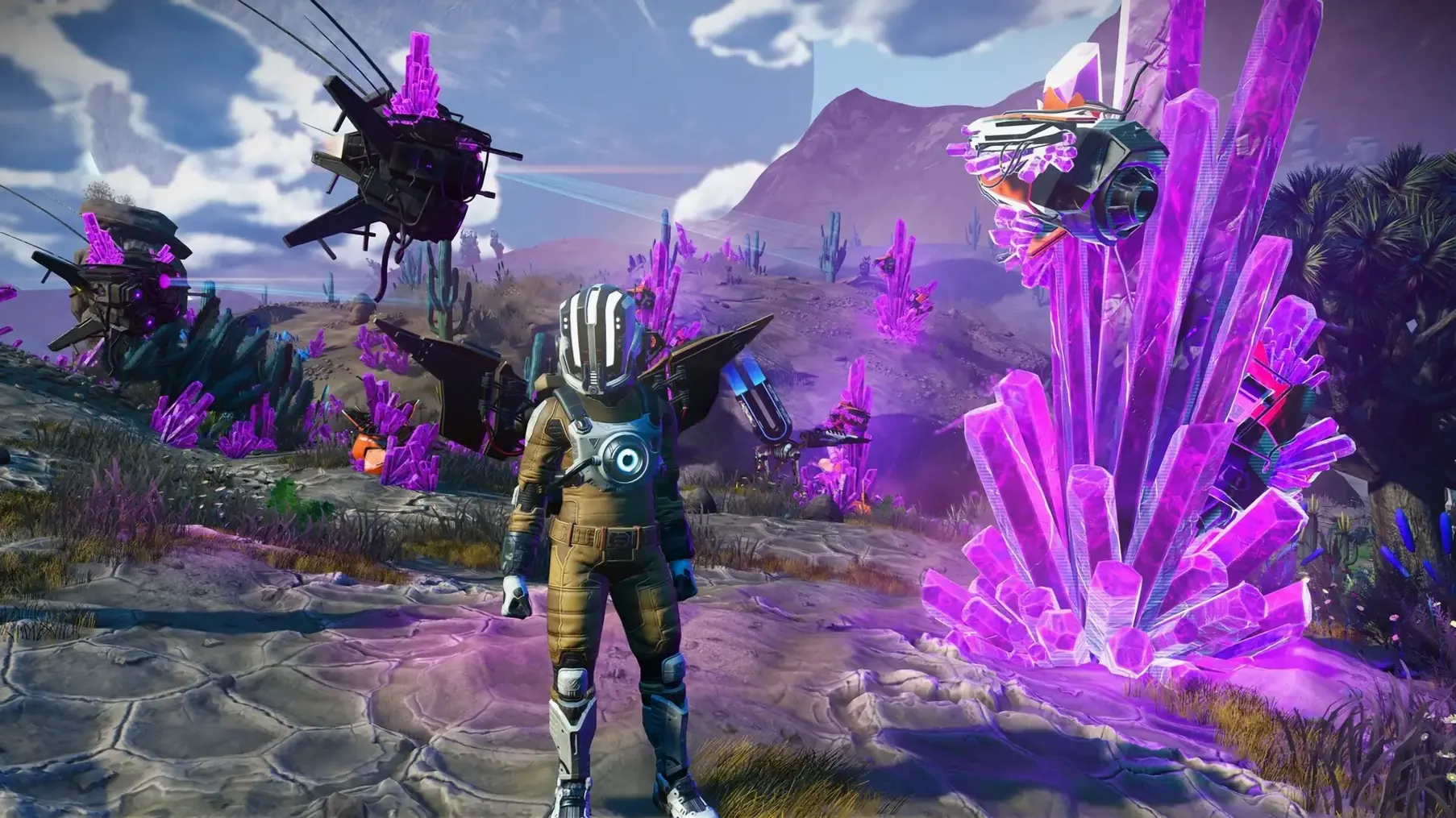
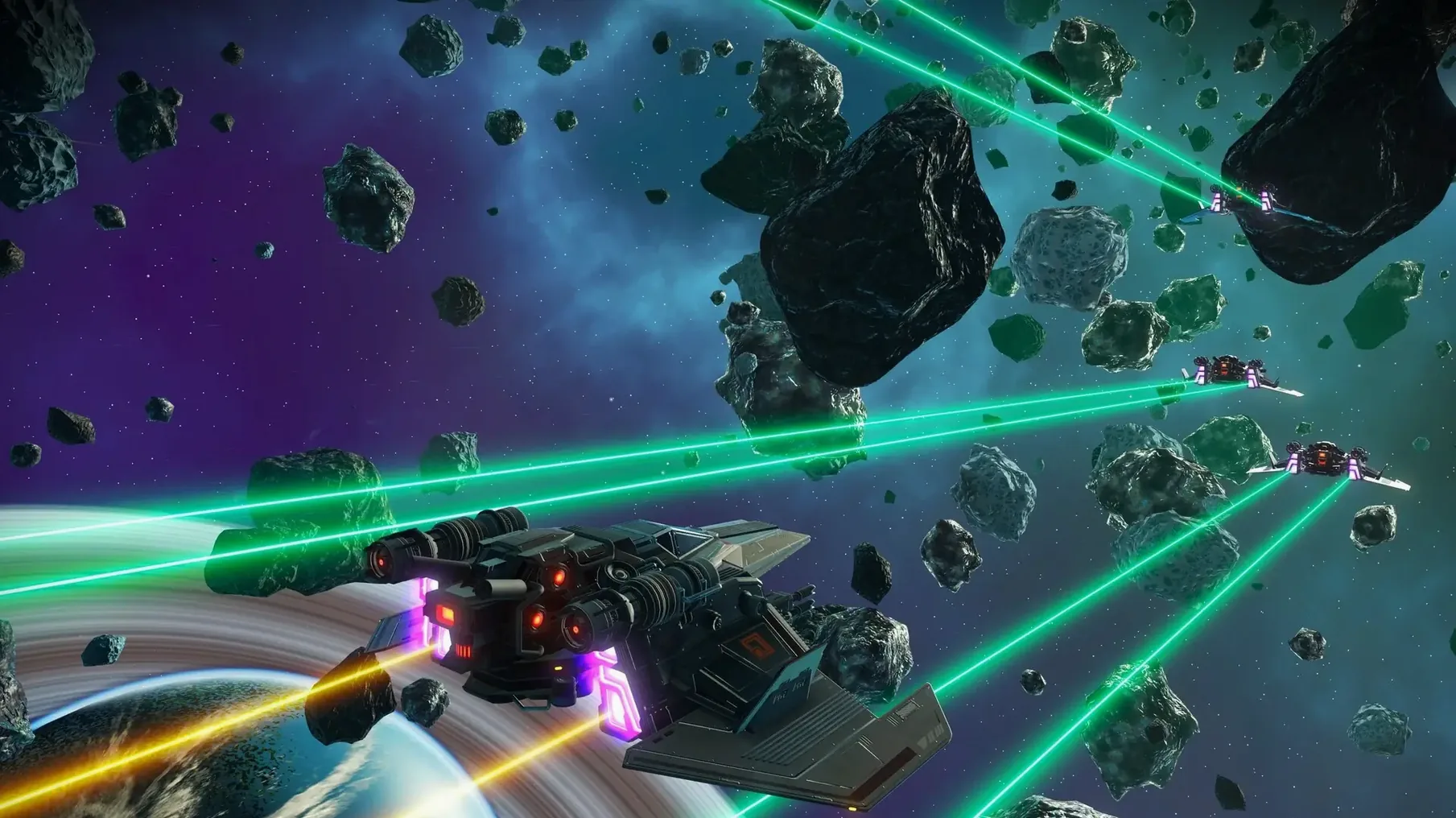
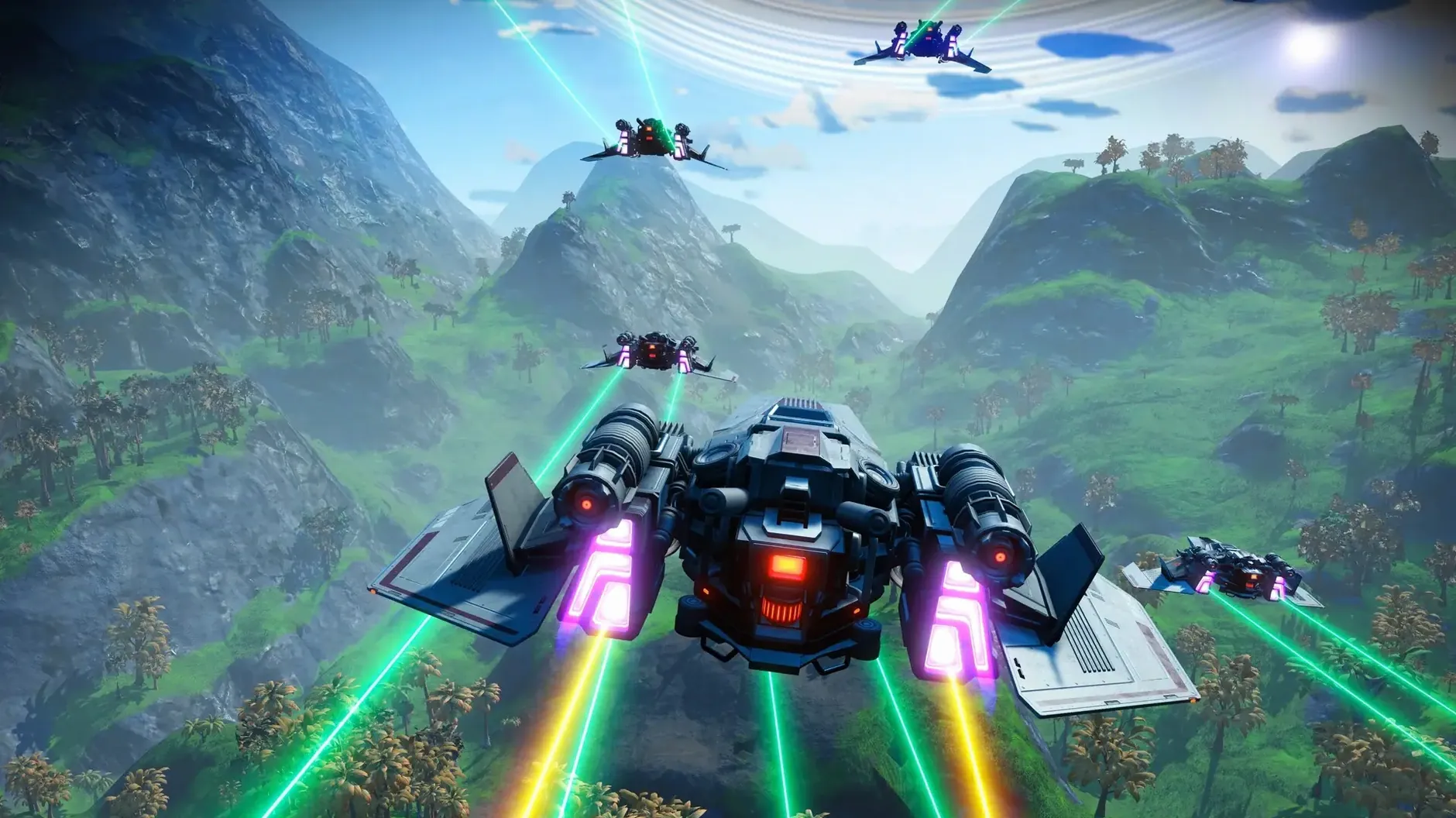
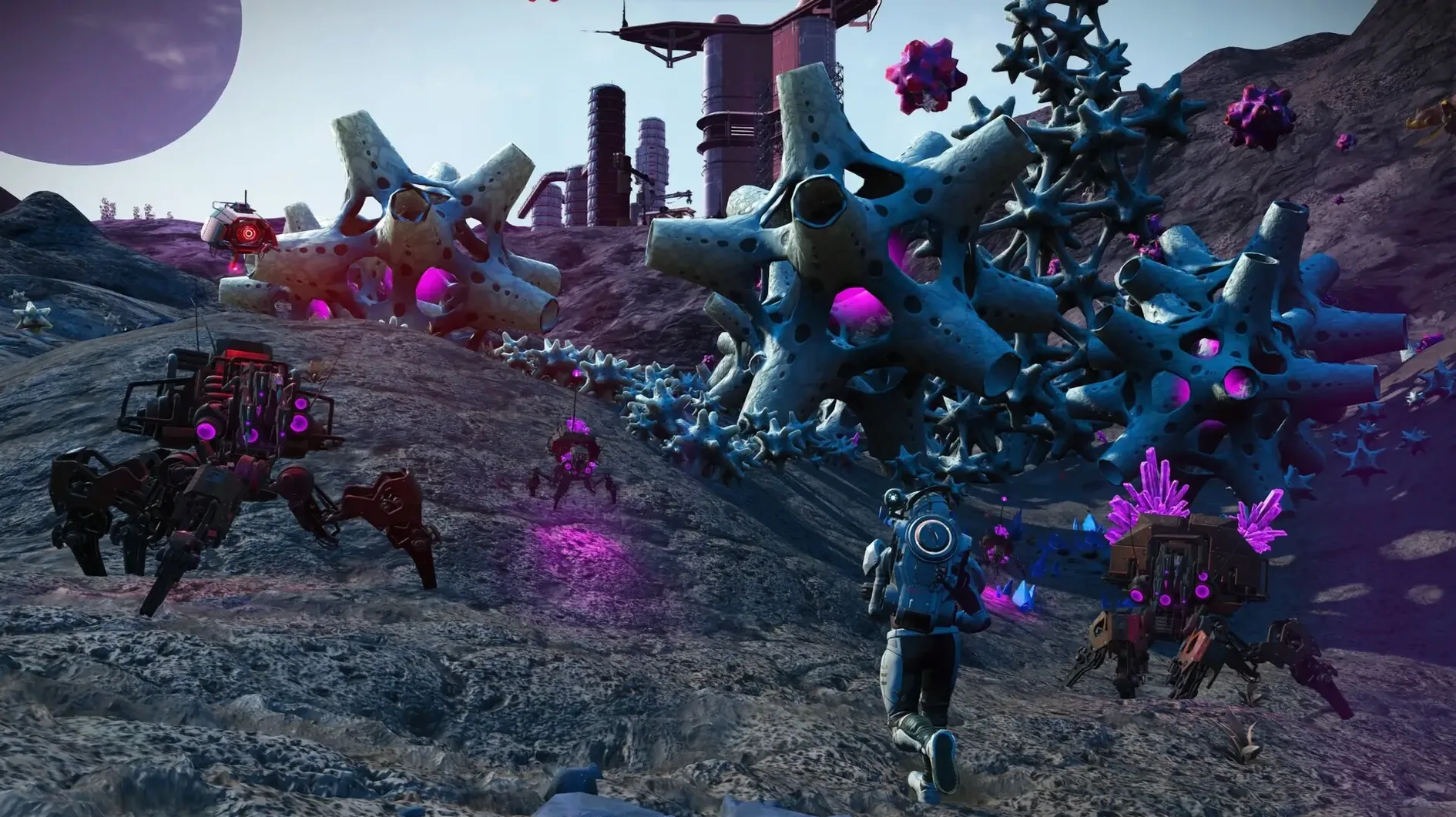
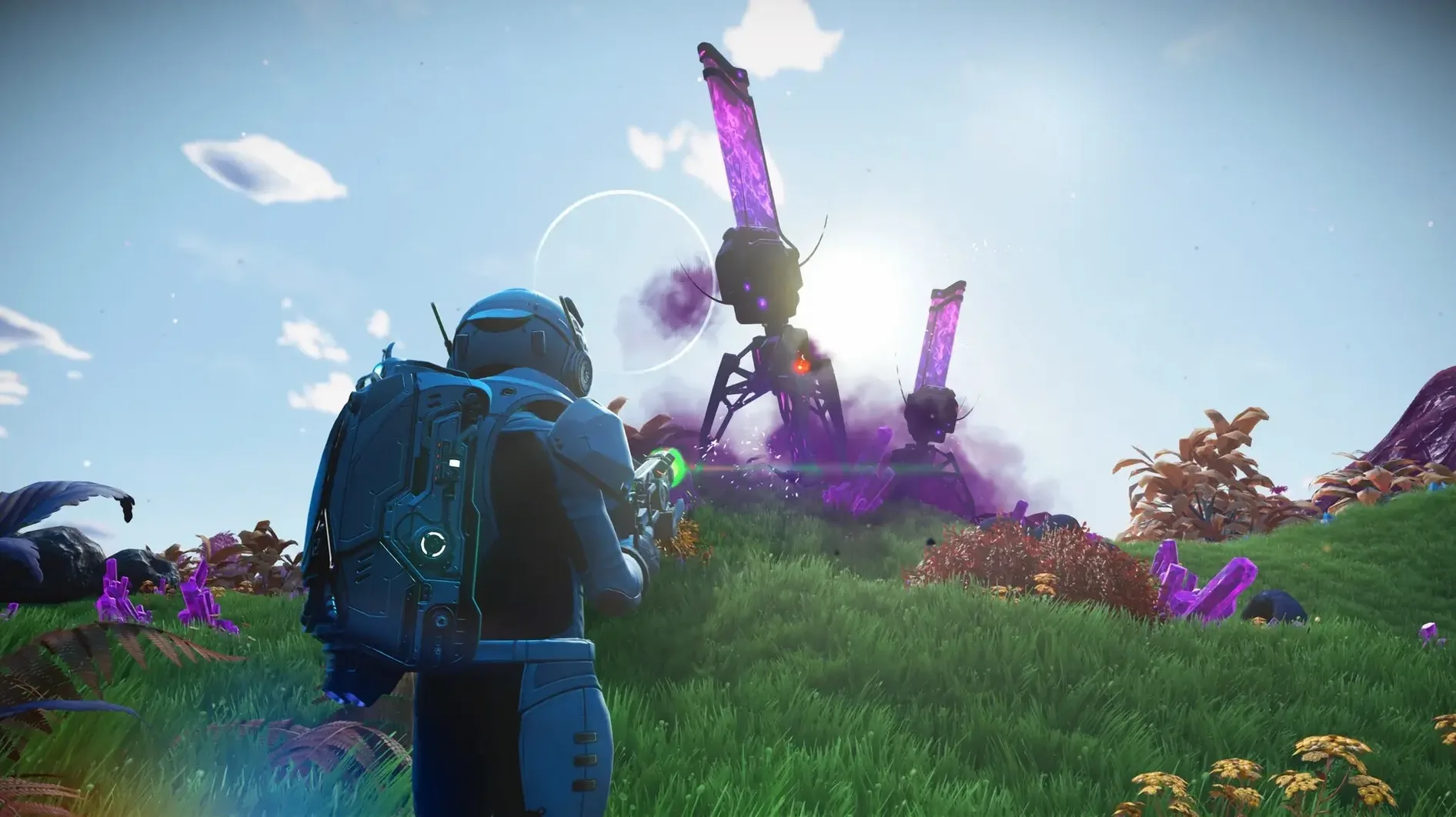
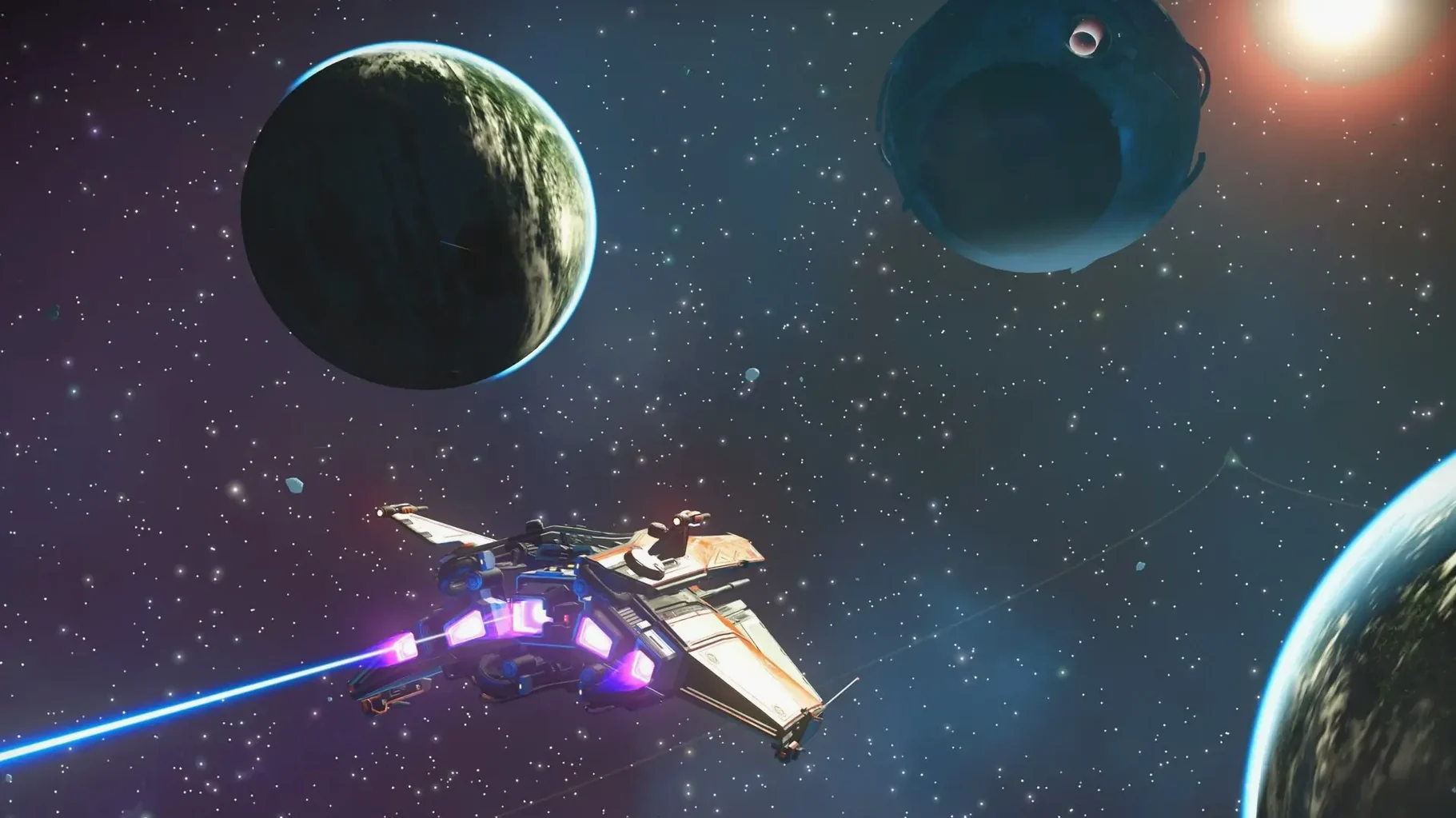
No Man's Sky is a space exploration game set in a procedurally generated universe where every distant star is a sun with planets orbiting it. You start on a random world with a basic ship and a broken multi-tool, then push outward at your own pace. Minute to minute, you're picking a direction and dealing with whatever you find — scanning unknown creatures, mining resources to refuel your launch thrusters, or dodging pirate scans in an asteroid field. The galaxy is shared, so discoveries you upload appear on a communal map of known space.
| Detail | What you get |
|---|---|
| Developer | Hello Games |
| Play style | Fight, trade, or explore freely |
| Shared world | One galaxy for all players |
| Languages | Russian, English, German, Spanish, Italian, Traditional Chinese, Simplified Chinese, Korean, Dutch, Polish, Portuguese, French, Japanese |
You can upgrade your ship, suit, and multi-tool as you go, and the galaxy isn't empty — trading convoys, faction fleets, and system police all go about their business whether you interact with them or not. The Mac version folds in every major content update from the past seven years, so the same depth that longtime players know is here from the start.
What a photographer might get out of it
Consider someone who runs a small portrait studio and unwinds by hunting for striking landscapes. In No Man's Sky, every planet is a lighting experiment. One dusk might throw amber across a ringed gas giant while bioluminescent grass pulses underfoot. Another system drops you inside a monochrome storm where the only color is your ship's exhaust.
That photographer won't care much about fleet management or min-maxing a starship weapon. They'll spend an hour repositioning their character so a diplo's neck curves against two moons, then upload the screenshot to a community that gets it. The game's photo mode — with adjustable focal length, depth of field, and time-of-day — turns the galaxy into a studio you don't have to rent. A lot of those shots end up as desktop wallpapers or reference for matte painting, and the shared discovery map means other explorers see where the shot was taken and can visit the same coordinates.
Sprint past glowing plants and you’ll choke on a dead planet
Most early frustration comes from three habits. The first is ignoring sodium and oxygen. The game drops you into a survival scenario without fanfare, and the yellow and red plants you sprint past in the first two minutes are what keep your hazard protection and life support from bottoming out. Grab more than you think you need.
The second is treating the starter multi-tool like it's permanent. Even a modest upgrade to scanning range and mining speed changes the early loop from a grind to a rhythm. Visit a space station's multi-tool vendor before you leave your first system — the price is low and the improvement is immediate.
The third is bolting for the galactic core. New players sometimes assume that's the goal and ignore everything else. The game opens sideways, not forward. Build a base, hire an overseer, follow the base computer's archive quests. Those teach you blueprints and mechanics the core rush skips entirely.
Drifting ships and a 1:1 Milky Way where heat builds in silent space
No Man's Sky vs. Elite Dangerous. Elite leans hard into simulation — flight-assist toggles, heat management, a ship that drifts if you cut thrust. Its galaxy is a 1:1 Milky Way model, so the scale feels colder and more scientific. No Man's Sky trades that fidelity for color and spontaneity. You land on planets in seconds with no loading screens, and the fauna are deliberately surreal. Where Elite asks you to master a cockpit, No Man's Sky asks you to wander.
No Man's Sky vs. Astroneer. Astroneer shares the deformable terrain and crafting loop but stays within a solar system. Its vibe is playful and low-stakes — tethers, buggies, and pastel landscapes. No Man's Sky adds combat, fleet management, and multiplayer hub missions on the Anomaly. If Astroneer is a sandbox, No Man's Sky is a sandbox with a star chart, a pulse engine, and occasional pirate raids.
No Man's Sky vs. Star Citizen. Star Citizen aims for fidelity down to cargo physics and player-driven economy, but it's not a finished product and its Mac support is non-existent outside workarounds. No Man's Sky runs natively on Apple silicon, includes seven years of content updates, and lets you play entirely offline if you want. The trade-off is simpler ship handling and less granular ship interiors, but the package is complete and coherent right now.
Tip: if you're coming from Elite or Astroneer, remap the flight controls in the first ten minutes. The default stick sensitivity can feel loose, and a few tweaks make the transition less jarring.
Waking to a humming teleporter under a sky full of rings
I load my save inside a planetary base I built on a humid moon. The teleporter hums in the corner; outside the glass, a ringed planet fills half the sky. I check the frigate fleet from the bridge terminal — two expeditions returned overnight, one brought back a stack of activated indium and a damaged support frigate I'll need to repair later.
First decision: do I need units, nanites, or a new multi-tool slot? I'm short on nanites, so I open the discoveries tab and upload the half-dozen flora and mineral scans I forgot to submit yesterday. That's a quick two thousand nanites. I spend them at the Anomaly on a jetpack upgrade module, then pick up a weekend mission from the Nexus — eliminate hazardous flora on a scorched planet — because the quicksilver reward will go toward a new base decoration I've had my eye on.
I pulse to the target system. A freighter battle triggers on entry; I ignore it and land on the mission planet. The heat is brutal, so I pop a thermal protection module and work through the hazard. The flora spit toxic clouds, which is annoying enough to make me swap to the scatter blaster. Five minutes of cleanup, mission complete.
Before heading back, I spot a trading post on the other side of the valley. I fly over, chat with the pilots, and buy a cheap B-class shuttle with a cargo layout I like. I'll scrap it at the station for parts and a storage augmentation — a trick that feels like a small economy game nested inside the larger loop. Back at the Anomaly, I hand in the mission, wave at a random Traveler who's dancing near the quicksilver merchant, and log out on a bench overlooking the landing bay.
Version 7.04 lands with the Cosmos update and a round of gameplay and stability fixes that keep things running smoothly.
- Runs on Intel and Apple Silicon Macs
Questions from the stall
Do you need to play online?
You can play offline as a solo explorer, but connecting lets you share planet and creature discoveries on the communal map of known space.
Does the Mac version include all the updates?
Hello Games says the Mac release includes every content update from the past seven years, so you get the full experience from the start.
Notes from other shops 0
Sign in or open a shop account to leave a note.
No notes yet. If you've used this on a shop Mac, tell me how it went.