
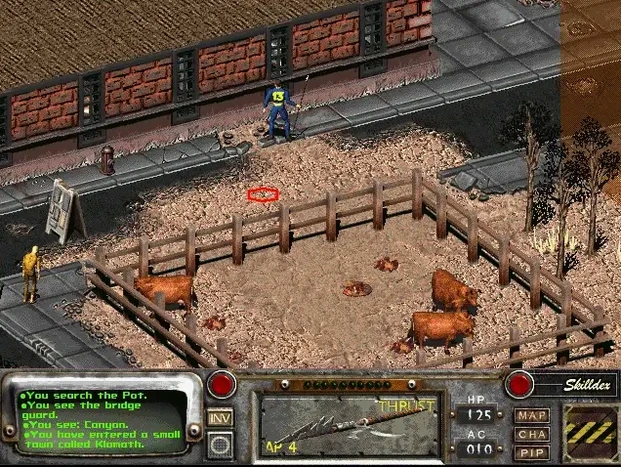
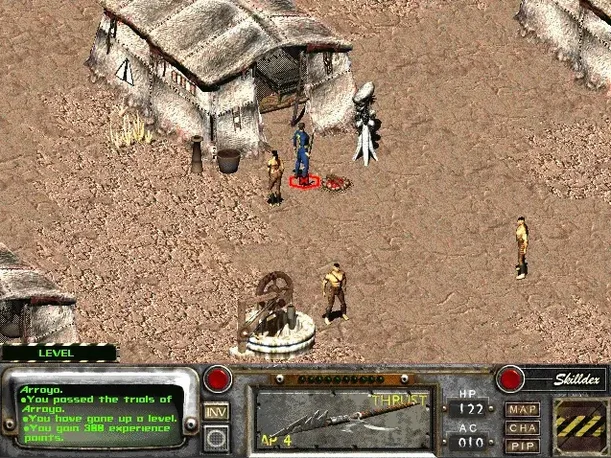
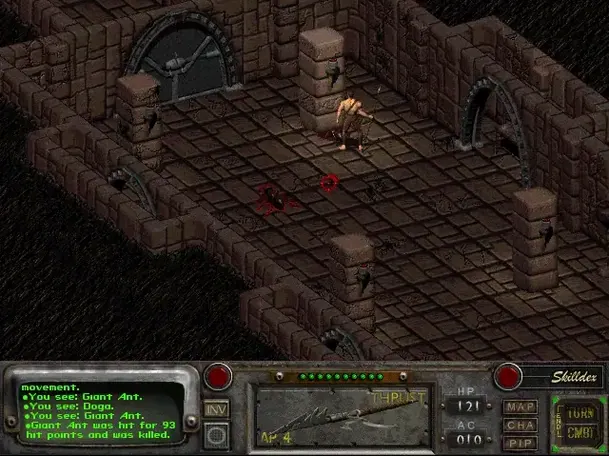
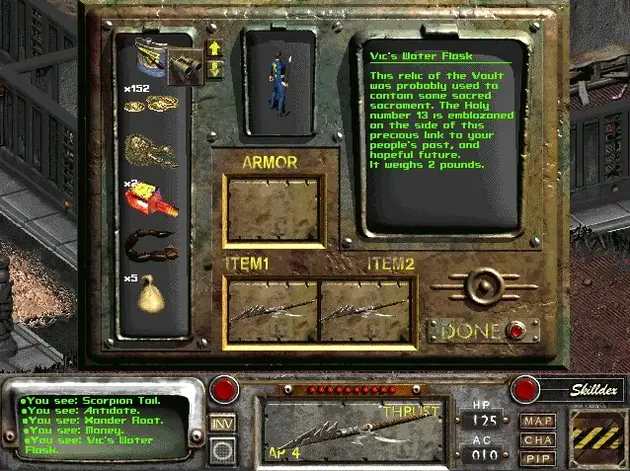
Fallout 2 is a turn-based role-playing game where a tribal descendant searches a retro-future wasteland for a device that can save their dying village.
Where lying and low cunning open more doors than a lockpick
- Players who enjoy reactive stories where deception and betrayal are common tools, not just flavor text.
- Anyone who likes character building where skill tags and traits genuinely lock or open paths through the wasteland.
- Fans of a grim, satirical tone — radiation hazards, desperate settlements, and mutants are treated with a dark sense of humor.
You begin as a tribal outcast, not a hero in waiting
- The turn-based combat is slow and unforgiving. A poorly built character will struggle, and early-game encounters can feel punishing.
- This is not a power fantasy. The setting is bleak, and being a tribal outcast means you start with little respect or gear.
- The interface and mechanics show their age. Expect to spend time learning how things work rather than being guided.
Launches without a hitch on an M1 MacBook Air
I loaded the game on a MacBook Air with an M1 chip and macOS Ventura — nothing fancy, just a quiet weekday machine. The build includes both ARM and x86 64‑bit slices, and it launches without a hitch either way. Load times are practically nonexistent; clicking the icon drops you into the main menu faster than most text editors open. During play, the frame rate holds steady even when the screen fills with particle effects from a flamethrower ambush or the flicker of a dozen radioactive campfires. I noticed the fan never spun up once — the game barely registers on system resources.
Stability is what you’d hope for from a GOG‑wrapped release. No crashes across several three‑hour sessions, no stuttering when rotating the isometric camera or scrolling across large map areas. Memory usage hovers around 200 MB, which leaves plenty of room for a browser full of walkthrough tabs and a music app in the background. If you’re juggling other work on the same machine, Fallout 2 sits politely in the corner and stays out of the way.
One way to approach Arroyo’s temple
The first hour can feel like a locked door if you don’t know where the handle is. Here’s a workflow that turns the opening temple into a deliberate training ground rather than a frustration:
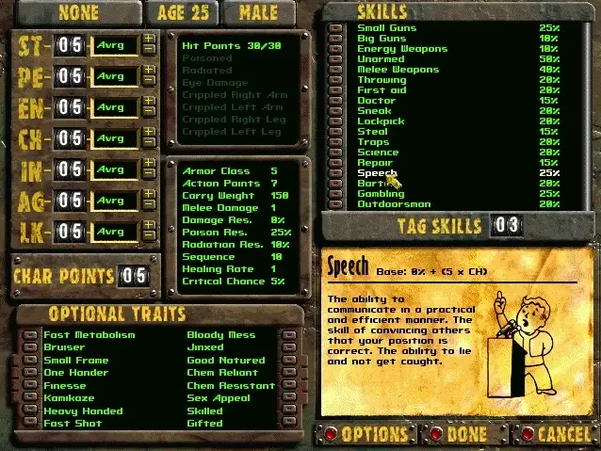
- Tag skills with intent. Before leaving character creation, tag Unarmed, Lockpick, and Speech. Unarmed handles the temple’s ant‑and‑scorpion gauntlet without burning through scarce ammunition. Lockpick opens a side door later that holds extra healing powder. Speech gives you an early negotiation option with a key NPC right after the temple.
- Move in combat mode deliberately. Enter turn‑based mode the moment you spot an enemy. Spend action points on a single aimed punch, then step one hex away. Ants and scorpions waste their turns closing the gap, and you avoid the poison sting that ends too many first attempts.
- Search every container before the trial room. Pots, urns, and floor piles in the temple corridors hold throwing knives, flares, and a few stimpaks that make the final trial fight manageable. Drag the cursor along walls — two containers are half‑hidden behind cracked pillars.
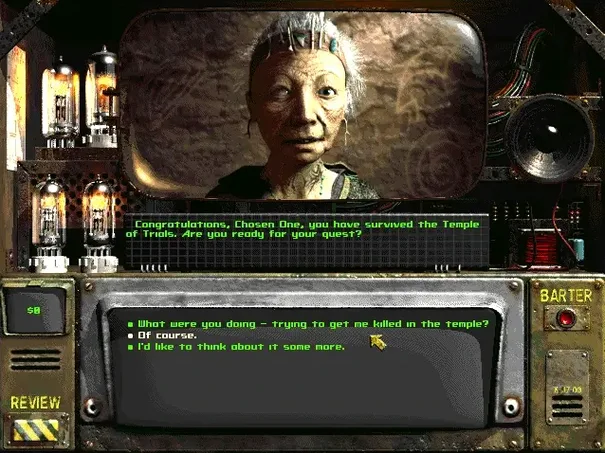
- Talk to the guard before the exit. After clearing the temple, use the Speech check on the bridge guard. A successful roll skips a repetitive fight and opens a minor reputation shift that pays off hours later in Klamath.
Tip: Save in a fresh slot before entering the trial room, not just a quicksave. The corridor layout makes retreat impossible once the door locks.
Compared to similar wasteland RPGs
Wasteland 2 (Director’s Cut). Party‑based, fully 3D, and built for modern systems. Wasteland 2 shares the desert‑ranger DNA and skill‑check philosophy, but its combat is squad‑tactics with cover systems, not lone‑wanderer turn‑based. It offers more granular inventory management and a much longer campaign. What it lacks is Fallout 2’s tight, personal scale — you manage a team, not a single tribal trying to talk their way past slavers with a rusty pipe in hand.
UnderRail. A spiritual successor that narrows the focus to underground metro tunnels and psychic abilities. UnderRail is harder, meaner, and less forgiving in its economy. The turn‑based combat feels tighter and faster, but the writing leans earnest instead of satirical. If Fallout 2 is a dark comedy, UnderRail is a survival logbook. Both reward oddball character builds, though UnderRail punishes a bad build faster.
ATOM RPG. Built by a team that clearly studied the first two Fallout games with a magnifying glass. ATOM mimics the isometric view, the skill‑based dialogue checks, and the Soviet‑era ruin aesthetic. It runs natively on Apple Silicon, and its interface feels slightly more responsive on modern screens. The trade‑off is a less memorable soundtrack and fewer absurdist encounters — ATOM plays its setting straighter, for better or worse.
Where Fallout 2 still stands apart is in how much it trusts you to fail. None of the newer titles lets you bumble into a shotgun wedding, accidentally join a crime family, or lock yourself out of the main quest by insulting the wrong person five minutes in. That looseness can frustrate, but it also makes every revisit feel like a story you haven’t heard yet.
- macOS Ventura
- Apple Silicon and Intel Macs
Questions from the stall
What is the main goal in Fallout 2?
You play as a descendant of the original Vault Dweller, searching for the Garden of Eden Creation Kit to save your primitive village from drought and extinction.
What languages does this version include?
The game's interface supports Russian and English. Russian-language files can be manually placed into the data folder for full localization.
Notes from other shops 0
Sign in or open a shop account to leave a note.
No notes yet. If you've used this on a shop Mac, tell me how it went.